
Mission-critical delivery is one of the most misused phrases in logistics. Many businesses apply it to any urgent shipment, but what does mission-critical delivery mean in operational terms? It means the transport of goods so integral to business survival that failure is not an option. Not delayed. Not rerouted. Not partially fulfilled. The definition carries a zero-tolerance standard that separates it entirely from standard express or priority shipping. For logistics professionals and supply chain leaders, understanding this distinction is not academic. It directly shapes how you procure services, manage risk, and protect your operations from catastrophic disruption.
Table of Contents
- Key takeaways
- Defining mission-critical delivery
- The precision gap and why standard shipping falls short
- Operational frameworks for mission-critical delivery
- Mission-critical delivery examples across industries
- My perspective: why on-time metrics miss the point
- How Sddbyaba supports mission-critical deliveries across the UK
- FAQ
Key takeaways
| Point | Details |
|---|---|
| Zero tolerance for failure | Mission-critical delivery requires near-perfect reliability, not just fast transit times. |
| The precision gap is real | Standard shipping achieves roughly 95% on-time performance, which is insufficient for mission-critical cargo. |
| Speed alone is not enough | Consistency, redundancy, and exception management define true mission-critical delivery services. |
| Specialist frameworks are required | No-fail workflows, dedicated teams, and real-time oversight are non-negotiable for high-stakes shipments. |
| Human judgement still matters | Experienced couriers and on-board specialists remain critical when technology and standard processes fall short. |
Defining mission-critical delivery
The definition of mission-critical delivery is grounded in consequence, not speed. According to industry standards, mission-critical delivery involves the transport of goods whose absence or delay would cause an immediate halt to core operations, create safety risks, or trigger severe financial losses. The threshold is not inconvenience. It is operational collapse.
This is where the distinction from "business-critical" delivery matters. Business-critical processes are important and costly to interrupt, but operations can continue in a degraded state. Mission-critical delivery, by contrast, involves no fallback. If the shipment fails, the operation stops. A hospital running out of a specific surgical instrument mid-procedure. A manufacturing line halted because a single precision component did not arrive. A data centre unable to restore service because replacement hardware is sitting in a depot.
The reliability standard reflects this reality. Mission-critical systems require 99.9% or greater uptime, and the logistics supporting them must match that standard. Anything less creates exposure that no insurance policy can adequately cover.
Industries where mission-critical delivery meaning is most acutely felt include:
- Healthcare and pharmaceuticals: Temperature-controlled medicines, surgical supplies, and diagnostic equipment with strict timing requirements
- Manufacturing: Just-in-time components where a single missing part halts an entire production line
- IT and data infrastructure: Server hardware, networking components, and replacement parts for live systems
- Aerospace and defence: Aircraft-on-ground (AOG) parts requiring immediate delivery to restore flight operations
- Construction: Specialist materials or equipment needed to meet regulatory deadlines or safety obligations
The costs of failure in these contexts scale exponentially. Operational shutdowns, safety hazards, and long-term reputational damage are all on the table. That is the weight behind the term.
The precision gap and why standard shipping falls short
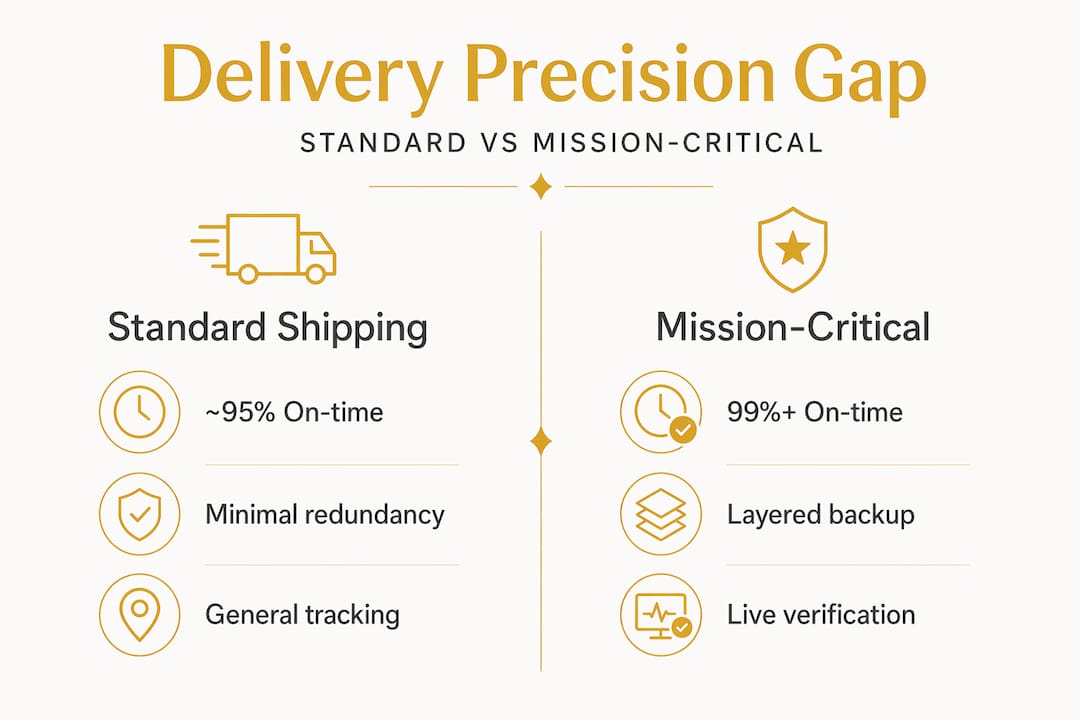
Here is a number that should concern every supply chain manager: standard shipping services maintain approximately 95% on-time delivery. For most commercial freight, that is acceptable. For mission-critical cargo, that 5% failure rate is catastrophic.
This is the precision gap. It is the distance between what general logistics networks deliver and what mission-critical delivery services must guarantee. Industry benchmarks now require 99% or better on-time delivery within defined windows for high-stakes supply chains. Some sectors demand even tighter performance.
| Metric | Standard shipping | Mission-critical delivery |
|---|---|---|
| On-time performance | ~95% | 99%+ |
| Failure tolerance | Acceptable within SLA | Zero tolerance |
| Exception handling | Reactive | Proactive and pre-planned |
| Tracking and visibility | Periodic updates | Real-time, continuous |
| Dedicated resource | Shared network | Dedicated vehicle or courier |
The consequences of falling into that gap are not theoretical. A delayed pharmaceutical shipment can compromise patient safety. A missed component delivery can cost a manufacturer tens of thousands of pounds per hour in halted production. A late IT hardware delivery can extend a data centre outage from hours to days.

Speed matters, but it is not the whole answer. A shipment can be fast and still unreliable if the network lacks redundancy or exception management. Faster transit reduces dwell time and exposure to handling risks, but speed without consistency is not a mission-critical solution. It is a gamble.
Pro Tip: When evaluating a logistics provider for mission-critical shipments, do not just ask about average transit times. Ask specifically about their exception management process and what happens when something goes wrong. That answer tells you more about their actual capability than any SLA document.
Delivery standards are also tightening across the industry. Leaders are now setting consistent 1 to 5 day nationwide targets with over 99% adherence in short-haul zones, driven by real-time data and dynamic routing. The bar is rising. If your logistics partner is not keeping pace, your mission-critical operations are exposed.
Operational frameworks for mission-critical delivery
Managing mission-critical deliveries successfully requires more than booking a faster courier. It requires a structured operational framework built around one principle: failure is not a scenario you recover from. It is a scenario you prevent.
-
Adopt a no-fail delivery model. No-fail workflows include redundant capacity, failover support, and risk-focused evaluation at every stage. Before a shipment moves, the risks are mapped and contingencies are pre-assigned. This mirrors the blue-green deployment principle from IT operations, where parallel systems run simultaneously until full validation is confirmed.
-
Use a Logistics General Contractor approach. Fragmented carrier management is a significant risk in complex, multi-leg deliveries. Unified command structures through a Logistics General Contractor role replace this fragmentation, ensuring proper sequencing, accountability, and real-time coordination across every stage of the delivery chain.
-
Deploy dedicated vehicles and resources. Shared networks introduce variability. For mission-critical shipments, a dedicated courier service removes that variability entirely. One vehicle, one driver, one consignment. No consolidation, no depot handling, no shared risk.
-
Integrate real-time tracking and intelligent dispatch. Continuous visibility is not a luxury in mission-critical logistics. It is a requirement. Dynamic routing, live status updates, and immediate escalation protocols allow teams to intervene before a delay becomes a failure.
-
Retain human expertise for exception handling. On-Board Couriers provide near-guaranteed delivery for extreme exceptions, relying on expert human judgement that goes beyond standard operating procedures. When a shipment is AOG-critical or facing an unpredictable disruption, experienced human decision-making is irreplaceable.
Pro Tip: Build your exception management plan before you need it. Identify your top five mission-critical shipment scenarios and document the escalation path for each. When a crisis occurs, you want decisions made in advance, not under pressure.
Customers in regulated sectors are also demanding transparency and operational verification from their logistics partners. Claims without evidence are no longer sufficient. Audit trails, proof of delivery, and documented exception responses are becoming standard requirements for mission-critical delivery contracts.
Mission-critical delivery examples across industries
Understanding how to define mission-critical delivery becomes clearer when you look at real operational scenarios. The stakes vary by sector, but the underlying standard is the same.
-
Emergency pharmaceuticals: A hospital pharmacy requires a specific blood product or temperature-sensitive medication within a two-hour window. The cold chain must be maintained throughout transit. A delay of even thirty minutes can render the product unusable or, worse, create a patient safety incident. This is commercial logistics at its most demanding.
-
Manufacturing line components: A car manufacturer operating a just-in-time production model discovers a critical batch of precision components was not delivered. The line stops. At an average cost of thousands of pounds per minute in lost production, every additional hour of delay compounds the financial damage. The component itself may be inexpensive. Its absence is not.
-
IT data centre hardware: A live data centre experiences a hardware failure. Replacement parts are needed within hours to restore service. Downtime costs for enterprise-level outages can reach hundreds of thousands of pounds per hour. The emergency delivery of that hardware is not a logistics preference. It is a business survival decision.
-
Aerospace AOG situations: An aircraft is grounded awaiting a specific part. Every hour on the ground costs the operator significant revenue and disrupts passenger schedules. AOG logistics require nationwide courier capability with immediate dispatch and no tolerance for network delays.
-
Construction and infrastructure deadlines: A specialist contractor awaits a critical component needed to pass a regulatory inspection. Missing the inspection window delays the entire project, triggering penalty clauses and pushing back completion dates. The delivery is mission-critical not because of the component's value, but because of what its absence costs.
What separates mission-critical logistics providers from standard couriers in these scenarios is not just speed. It is the combination of dedicated resources, pre-planned contingencies, real-time communication, and the operational discipline to execute without failure.
My perspective: why on-time metrics miss the point
I have seen businesses build their entire logistics strategy around on-time delivery percentages, and I understand why. It is a clean, measurable number. It appears in SLA documents, supplier scorecards, and board reports. But in my experience, on-time metrics mask the real risk in mission-critical environments. They tell you how often things went right. They tell you nothing about what happens when things go wrong.
The businesses that manage mission-critical delivery well are not the ones with the best average performance. They are the ones with the best exception management. They have thought through the failure scenarios, assigned responsibility, and built recovery into the process before anything moves. That is a fundamentally different mindset from chasing a percentage.
I also think the industry underestimates how much human judgement still matters. Technology is genuinely useful for tracking, routing, and dispatch. But when a shipment is in trouble at 11pm on a Sunday and the standard process has broken down, what you need is an experienced person who can make a call and act on it. Operational discipline and human expertise are not being replaced by software. They are being supported by it.
My advice to any supply chain leader: stop measuring your mission-critical logistics partners on averages. Start measuring them on how they perform when things go wrong. That is the only metric that tells the truth.
— Ayomide
How Sddbyaba supports mission-critical deliveries across the UK
When your operations cannot afford a failed delivery, you need a logistics partner built around that reality.
Sddbyaba provides same day courier services across the UK, purpose-built for time-sensitive and high-stakes shipments. From dedicated courier transport with single-consignment vehicles to freight haulage for complex or heavy mission-critical cargo, every service is designed around reliability, speed, and professional communication. Sddbyaba operates a fleet ranging from motorcycle couriers to articulated lorries, covering the full spectrum of mission-critical delivery needs. Whether you need an emergency pharmaceutical run, a manufacturing component delivered before a line stops, or urgent IT hardware dispatched nationwide, Sddbyaba is ready to move when it matters most.
FAQ
What does mission-critical delivery mean?
Mission-critical delivery refers to the transport of goods whose delay or failure would immediately halt core operations, create safety risks, or cause severe financial damage. It requires near-perfect reliability, typically 99.9% or greater, with zero tolerance for failure.
How is mission-critical delivery different from standard express delivery?
Standard express delivery operates on shared networks with approximately 95% on-time performance. Mission-critical delivery uses dedicated resources, pre-planned contingencies, and real-time oversight to meet a 99% or higher reliability standard with no acceptable margin for error.
What are common mission-critical delivery examples?
Common examples include emergency pharmaceutical transport, manufacturing line components for just-in-time production, IT data centre hardware replacements, aircraft-on-ground parts, and time-sensitive construction materials subject to regulatory deadlines.
Why is speed alone insufficient for mission-critical logistics?
Speed reduces transit risk but does not address consistency, exception management, or redundancy. A fast delivery that lacks failover planning or real-time oversight is still vulnerable to failure. True mission-critical logistics requires all three elements working together.
How should businesses choose a mission-critical delivery provider?
Businesses should evaluate providers on their exception management process, dedicated vehicle capability, real-time tracking, and documented proof of reliability. Average on-time statistics are less informative than understanding how the provider responds when a delivery faces disruption.