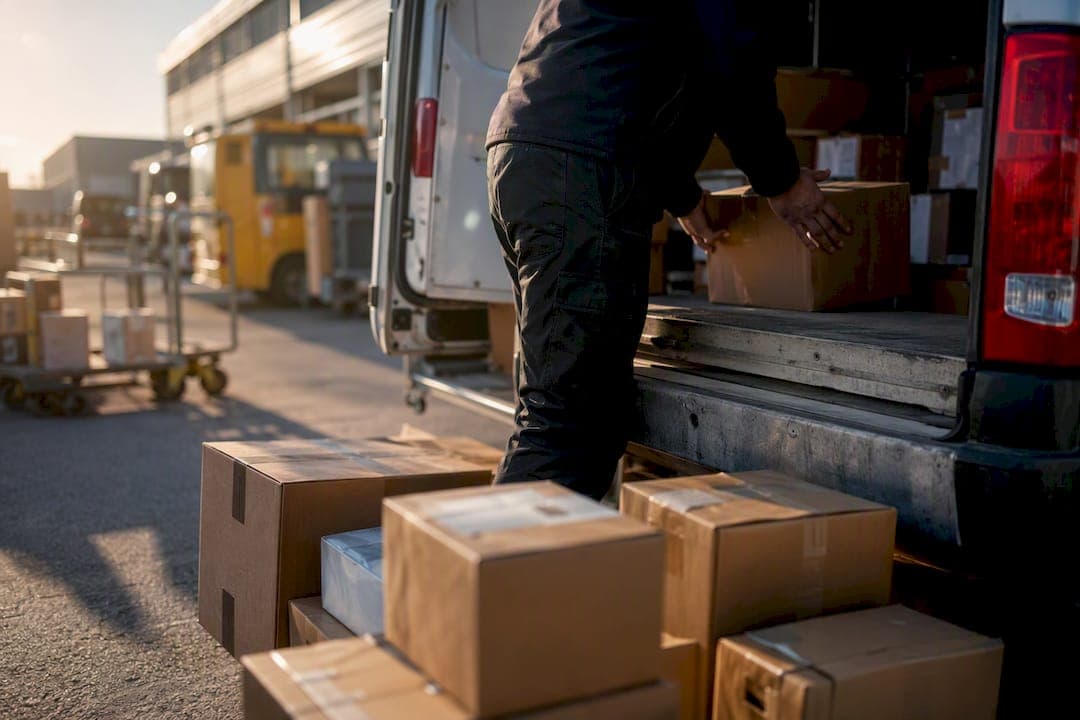
Coordinate a multi-drop courier route by verifying every address, grouping stops by geography and time window, matching vehicle size to load, then running route optimisation that supports dynamic re-optimisation as the day unfolds. Get this sequence right and you cut miles per stop while protecting your on-time percentage, which is usually the single biggest lever on delivery cost.
Before you dispatch anything, run this checklist:
- Verify data: full postcodes, weight, dimensions, access notes for every stop.
- Set boundaries: confirm depot start/end points and each customer's time window.
- Match vehicles: capacity and access restrictions before you sequence, not after.
- Run optimisation: use a planner that respects driver hours and vehicle capacity.
- Dispatch with tracking: live visibility plus proof of delivery on every drop.
Three trust markers worth checking with any provider: compliance with statutory driver hours rules, genuine same-day capability, and proof-of-delivery on every stop, not just the last one.
Key Takeaways
Coordinating a multi-drop courier route successfully depends on clean address data, logical geographic clustering, correct vehicle matching, and optimisation software that supports dynamic re-optimisation throughout the shift.
| Point | Details |
|---|---|
| Data quality comes first | Verify full postcodes, weight, dimensions, and access notes before any clustering or sequencing begins. |
| Cluster before you sequence | Group stops by geography and compatible time windows, then fix depot start and end points. |
| Match vehicle to load | Use vehicle classes from motorbike to 26 tonne truck based on volume and site access restrictions. |
| Dynamic re-optimisation matters | Static morning plans lose to routes that can adjust mid-shift for delays or new orders. |
| Sddbyaba runs the full workflow | From order intake to proof of delivery, Sddbyaba coordinates multi-drop routes across a fleet from motorcycles to artics. |
Table of Contents
- What is a multi-drop courier route?
- What are the business benefits of planning routes in advance?
- How do you coordinate and plan a multi-drop courier route?
- How do you match vehicle type to a multi-drop load?
- How does SDD by ABA coordinate multi-drop routes?
- How is multi-drop courier pricing and timing calculated?
- What red flags should you watch for when choosing a multi-drop courier?
- Get a quote for your multi-drop courier route
- Sources
What is a multi-drop courier route?
A multi-drop courier route is a single vehicle journey planned to complete several deliveries or collections in one run, sequenced for the shortest practical distance and the tightest time windows. It differs from ad hoc bookings, where each job is dispatched separately with no shared routing logic.
Typical use cases include retail bulk dispatch to multiple stores, scheduled B2B rounds between depots and clients, pallet distribution across a region, and timed medical or legal drops where a missed window has real consequences.
A dedicated planned route earns its keep once you're running:
- Multiple stops per day on a recurring basis.
- Tight SLA windows that ad hoc booking can't reliably hit.
- Enough volume that cost per stop starts to matter more than per-job convenience.
What are the business benefits of planning routes in advance?
Planned routes cut miles per delivery, which drops fuel spend and driver hours in the same motion. Enterprise routing engines that continuously re-optimise as constraints shift consistently outperform static, once-a-day route plans, particularly on fleets running more than a handful of vehicles.
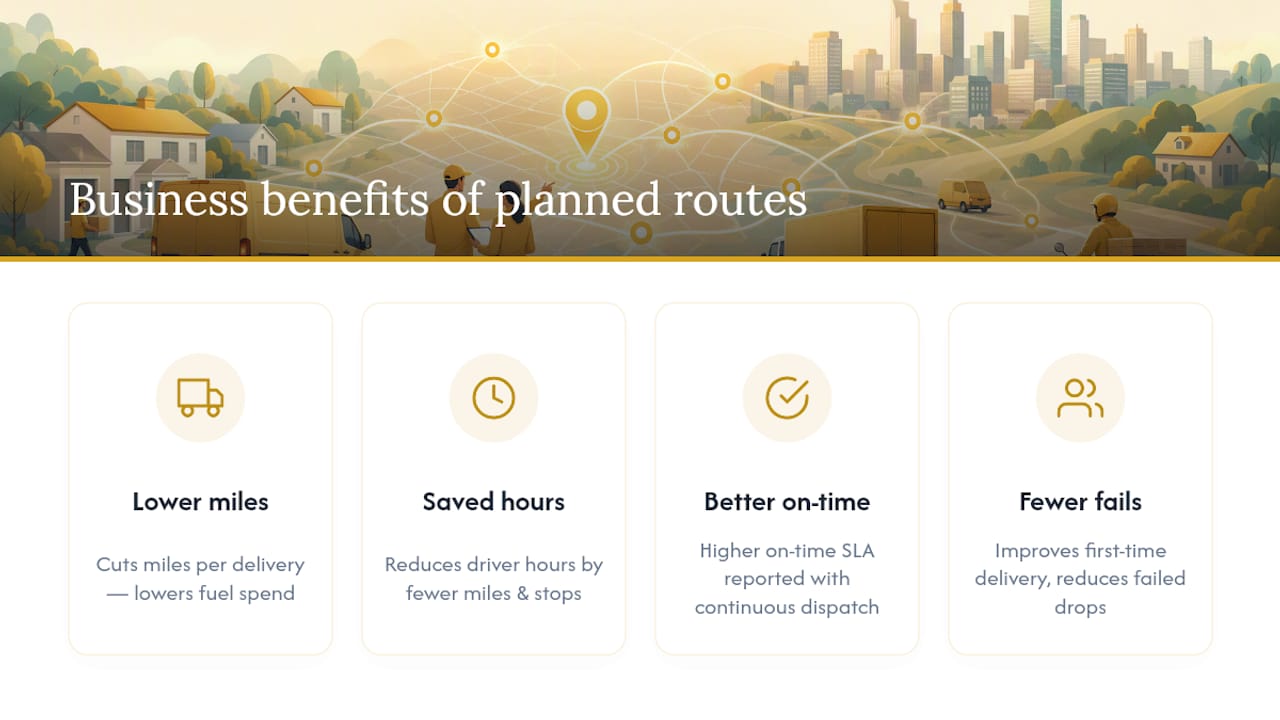
Beyond the direct cost line, planned multi-drop routes improve first-time delivery rates, reduce failed-drop exceptions, and give drivers a predictable shift instead of a reactive scramble.
Pro Tip: Track three numbers weekly: miles per stop, deliveries per vehicle per day, and on-time percentage. If miles per stop climbs while stop count stays flat, your clustering logic has drifted and needs a rebuild.
Some fleets deploying continuous, ML-driven dispatch have reported meaningful on-time SLA gains and route distance reductions after moving off static planning, though results vary by fleet size and route density.
How do you coordinate and plan a multi-drop courier route?
Coordinating a multi-drop route is a sequence, not a single decision. Skip a step and the savings you planned for evaporate somewhere between the depot and the third stop.
-
Clean your data first. Full postcodes, accurate weight and dimensions per stop, clear pickup versus delivery flags, and access notes (loading bay, buzzer code, restricted hours). Bad data is the single most common cause of route failure, and no optimiser can fix it after the fact.
-
Cluster stops by geography and time window. Group drops that sit near each other and share compatible windows, then fix your start and end points, usually the depot or a driver's home base.
-
Sequence with an optimisation engine. A proper route planner should weigh time windows, vehicle capacity, driver hours, and low-emission zone restrictions simultaneously. Google's Route Optimization API handles this at a technical level, accepting shipments and constraints and returning sequenced stops via methods like optimizeTours. For smaller fleets, simpler browser-based planners using nearest-neighbour and 2-opt heuristics can sequence up to 100 stops without any developer involvement.
-
Assign vehicles and drivers by capacity and skillset, then make sure the manifest order matches how the vehicle is physically loaded. A manifest that ignores loading order forces drivers to unload and reload cargo mid-route, which quietly erodes every minute you saved through sequencing.
-
Dispatch with live tracking and a clear rule for changes. New orders, delays, and cancellations happen daily. Continuous re-optimisation mid-shift, rather than a fixed morning plan, is what separates high-performing fleets from average ones.
-
Capture proof of delivery at every stop. Timestamps, signatures, or photographic evidence should feed straight back into your dispatch system, so exceptions trigger automatic rescheduling rather than a phone call an hour later.
How do you match vehicle type to a multi-drop load?
Vehicle selection shapes everything downstream, from how many drops you can fit in a shift to whether you can even enter certain sites; learn more about road freight transport management system capabilities that support this process. A motorbike suits single small parcels through central access restrictions; a small or medium van covers most retail and B2B rounds; a Luton van handles bulkier volume with rear-loading convenience; and 7.5 tonne, 18 tonne, or 26 tonne trucks step in for palletised freight or high-stop-count regional runs. Our guide to courier vehicle selection breaks these classes down by payload and typical use case.
Loading order matters as much as vehicle size. Sequence the manifest so the last stop is loaded first, matching physical loading to route order and avoiding costly re-handling at each stop.
- Mixed fleets suit routes with both bulky pallets and small urgent parcels.
- Check low-emission zone permits before routing larger vehicles through city centres.
- Workplace transport guidance from the HSE is worth reviewing for loading bay safety and on-site vehicle movement.
How does SDD by ABA coordinate multi-drop routes?
Our workflow follows the same discipline we've outlined above, built around order intake, address verification, clustering and optimisation, vehicle assignment, a loading manifest, and live dispatch with proof of delivery on every stop.
Multi-drop coordination succeeds or fails at the data stage. Every stop we add without a verified postcode or access note is a delay we're choosing to build into the route before the van even leaves the depot.
What this looks like in practice across our fleet:
- Same-day dispatch capability alongside scheduled, recurring multi-drop routes.
- A fleet range from motorcycles and small vans through to 18 and 26 tonne trucks and artics.
- Real-time exception handling when orders change or access is delayed mid-route.
We work across construction, retail, healthcare, and commercial logistics, where the cost of a missed window is rarely just financial.
How is multi-drop courier pricing and timing calculated?
Pricing for a multi-drop run comes down to a handful of variables: total distance, number of stops, vehicle type, how tight your time windows are, parcel size and weight, and any surcharges for fuel or low-emission zone access. Our breakdown of courier cost factors covers these in more depth.
Timelines differ sharply by service type. Scheduled multi-drop routes typically need lead time to book vehicles and confirm windows, while dedicated same-day runs can often be arranged within hours, subject to fleet availability and cut-off times.
When requesting a quote, include:
- Start and end postcodes, plus total stop count.
- Parcel or pallet dimensions and weight per drop.
- Required time windows and any access restrictions.
- Proof-of-delivery format needed (signature, photo, timestamp).
What red flags should you watch for when choosing a multi-drop courier?
Vague quotes are the clearest warning sign. If a provider can't break down cost by distance, stop count, and vehicle type before you book, expect surprise charges once the invoice lands.
A second red flag is no visibility into driver hours compliance. Any operator running multi-drop routes at volume must plan shifts around statutory rest and driving-time rules. If a courier can't explain how they schedule around these limits, they're either cutting corners or don't fully understand their own operation.
Watch for proof-of-delivery gaps too. A courier offering POD only on the final stop of a route, rather than every drop, leaves you unable to resolve disputes on stops two through nine.
Fleet mismatch causes quiet failures. A provider that always sends the same van size regardless of your load will either waste capacity or squeeze your consignment into a vehicle that can't legally or safely carry it.
Finally, be wary of providers with no clear process for mid-route changes. Deliveries get cancelled, addresses change, and new urgent orders appear mid-shift. If a courier's answer to a last-minute change is "we'll try to fit it in tomorrow," that's not a multi-drop service, that's a single-drop service with extra steps. Ask how they handle dynamic re-optimisation before you sign anything.
Operations manager: what actually breaks a route
The recurring failure point isn't traffic or weather. It's a customer address that changes at 8am, after the manifest is already loaded in the wrong order for the new sequence. Enforce full postcode capture at order intake. It solves more problems than any optimisation software ever will.

Get a quote for your multi-drop courier route
Coordinating your own multi-drop routes takes real planning discipline, clean data, the right vehicle mix, and a system that can re-optimise when the day doesn't go to plan. If that's more overhead than your operation wants to carry in-house, Sddbyaba runs that entire workflow for you, from same-day multi-drop dispatch to dedicated vehicle transport and palletised freight, across a fleet that spans motorcycles through 26 tonne trucks and artics.
Getting a quote is straightforward. Send us your start and end postcodes, total stop count, parcel or pallet dimensions, required time windows, and your proof-of-delivery expectations. Our team typically responds fast, because same-day capability means nothing if the quote itself takes two days. For scheduled, recurring routes, our commercial logistics service is built specifically for regular multi-drop contracts rather than one-off jobs.
Whether you need a single dedicated van for a tight regional round or a heavier vehicle for palletised drops, request a quote through Sddbyaba and get a route plan built around your actual constraints, not a generic template.
Sources
For hands-on sequencing, a free browser-based route optimiser suits small fleets and independent couriers. Developers building custom dispatch tools should look at the Route Optimization API. For statutory scheduling limits, consult official driver hours guidance directly.
- Route planning and scheduling / multi‑drop route planner (Descartes)