
The fastest way to optimise a courier dispatch schedule is simple: dispatch immediately for time-critical, single-drop consignments, and hold for consolidation only when slack time and geographic clustering genuinely justify the delay. Get that one call right and everything else, from vehicle selection to SLA design, falls into place.
- Speed improves because urgent jobs stop competing with routine ones for controller attention.
- Cost falls because consolidation is used only where it earns its keep, not by default.
- Reliability rises because time to allocate, the gap between a job landing and a driver confirming it, becomes the metric everyone watches first, a discipline UK dispatch software specialists recommend leading with. SDD by ABA's dispatch model is built around exactly this principle.
Key Takeaways
Optimising a courier dispatch schedule depends on getting the dispatch-or-hold decision right at booking intake, backed by rules-based allocation and a measured, phased rollout.
| Point | Details |
|---|---|
| Dispatch-or-hold decision | Send immediately when slack is tight; only hold for consolidation with genuine clustering and slack. |
| Vehicle matching | Match motorcycle, van, tail-lift or heavier trucks to the job before considering driver speed. |
| Lead with time to allocate | Track the gap between job arrival and driver confirmation as the primary dispatch metric. |
| Run an 8 week tuning plan | Baseline for two weeks, assist for two, tune rules for two, then standardise for two. |
| SDD by ABA as proof point | SDD by ABA applies dedicated and consolidated dispatch choices across its UK same day, pallet and freight fleet. |
Table of Contents
- A quick decision checklist for optimising courier dispatch schedules at booking intake
- When should you dispatch immediately versus wait for consolidation?
- Which vehicle class fits which job, and when does it matter most?
- What booking details and SLA tiers reduce delivery failures?
- What metrics should you track to optimise dispatch, and how do you tune it over 8 weeks?
- How do you roll out a new dispatch schedule without breaking live operations?
- Why the “fastest driver” instinct is the wrong optimisation target
- How SDD by ABA supports your same-day dispatch schedule
- Frequently asked questions
- Sources
A quick decision checklist for optimising courier dispatch schedules at booking intake
Every booking that lands on a controller's desk needs the same five checks, run in the same order, whether it is a single parcel or a pallet of retail stock.
- Confirm the SLA required and tag priority. Is this a same-day guarantee, a timed slot, or a standard next-day job? Tag it immediately so it cannot slip down the queue.
- Verify pickup readiness and release time. A job that is not actually ready for collection for another 40 minutes should not be dispatched as if it were.
- Pick the correct vehicle class and decide dedicated versus consolidated. Match the asset to the load before anything else is planned.
- Check the consolidation opportunity. Look at distance clustering, weight and volume, and how much deadline slack exists.
- Select the communication level and capture contact details and handling requirements. Fragile, temperature-sensitive or high-value loads need this flagged at the point of booking, not discovered at collection.
Pro Tip: Run this checklist as a physical or digital form, not a mental habit. Controllers under pressure skip steps from memory long before they skip steps from a form.
When should you dispatch immediately versus wait for consolidation?
Same-day delivery orders arrive continuously through the working day, which forces a constant judgement call: send the driver now, or hold a few minutes for a second job nearby. That trade-off directly affects fulfilment rate, and research into same-day delivery operations confirms it is one of the central optimisation problems in the sector, not a minor scheduling detail.
A few working heuristics make the call easier:
- If deadline slack is tight, dispatch now. Do not gamble a guaranteed SLA on a maybe.
- If two or more jobs sit within a close radius and have sufficient slack, a short hold for consolidation usually pays off.
- If the vehicle is already at capacity, stop looking for consolidation candidates and dispatch, however tempting the next pickup looks.
- Set a hard stop-waiting signal of no more than a short window of minutes. Beyond that, the fuel and vehicle-time saved rarely offsets the risk of a late collection.
The most common failure mode is not indecision. It is controllers holding a job "just a bit longer" for a consolidation opportunity that never quite materialises, then scrambling to find a driver at the last possible moment. That single habit causes more missed SLAs than any vehicle shortage does.
Which vehicle class fits which job, and when does it matter most?
Vehicle selection is where most avoidable delay actually happens, because the wrong asset costs you twice: once in slower loading and again in restricted access at the drop.
- Motorcycle couriers suit urgent, small, lightweight parcels where speed through traffic beats carrying capacity every time.
- Small and medium vans cover the bulk of standard B2B parcel and light freight work, balancing speed with reasonable capacity.
- Luton vans with a tail-lift are the right call for pallets, bulky retail stock or anything that cannot be lifted by hand.
- 7.5 tonne trucks upward, through to artic lorries, handle larger freight and multi-pallet loads, but need to be booked earlier because of access and driver licensing constraints.
Vehicle choice also governs collection speed and loading time. A tail-lift van at a warehouse with no dock levelling can save notable minutes that a standard van simply cannot recover. For high-value, time-critical or medical consignments, dedicated point-to-point transport removes hub-and-spoke handling risk entirely, which matters more than the marginal cost difference once you factor in what a failed delivery actually costs a business.
What booking details and SLA tiers reduce delivery failures?
Every booking needs a minimum set of fields captured before dispatch, not after: ready time, a live contact, handling flags, and customs paperwork for any cross-border freight. Miss the ready time and the driver arrives to a closed loading bay. Miss the handling flag and a pallet gets stacked wrong.
SLA tiers keep controller effort proportionate to urgency:
- Guaranteed collection window (e.g. within 90 minutes): highest priority, dedicated vehicle, no queueing behind other jobs.
- Same-day standard: rules-based allocation, consolidation permitted within slack thresholds.
- Next-day scheduled: batch-planned, lowest controller intervention needed.
Notification cadence, booking confirmation, collection confirmation, en-route update, and electronic proof of delivery, shortens dispute windows dramatically, since structured ePOD workflows give both sender and recipient a timestamped record rather than a phone call after the fact.
Pro Tip: Trigger a re-plan automatically the moment an ETA exception fires, rather than waiting for the receiving customer to call and ask where their delivery is.
What metrics should you track to optimise dispatch, and how do you tune it over 8 weeks?
You cannot improve what you do not measure, and dispatch operations have a small set of metrics that matter more than the rest combined.
- Time to allocate — the gap between a job arriving and a driver confirming it. This is the metric to lead with, since it compounds directly into controller workload.
- Jobs per controller — how many bookings one person manages without errors creeping in.
- Driver acceptance rate — how often the first offered driver accepts the job.
- Reallocation rate — how often a job has to be reassigned after initial allocation.
- Late collections and first-attempt delivery success — the outcomes customers actually notice.
| Week | Focus |
|---|---|
| 1 to 2 | Baseline: collect all five metrics with no process changes |
| 3 to 4 | Assisted mode: introduce suggested allocation, controller still decides |
| 5 | Tune rules: adjust thresholds based on override patterns |
| 7 to 8 | Standard work: move routine jobs to rules-based allocation, controllers handle exceptions only |
A rules-based allocation approach, sitting between fully manual and full automation, captures most of the achievable gain for UK same-day operators while keeping a controller responsible for anything unusual. Every time a controller overrides a suggested allocation, log the reason. Those overrides are your tuning dataset, and reviewing them weekly is how the rules get sharper without a single line of new software.
How do you roll out a new dispatch schedule without breaking live operations?
Changing dispatch rules mid-operation is where good plans go wrong, usually through impatience rather than bad design.
Before launch, clean up vehicle and driver profiles (accurate capacity, access restrictions, current addresses), validate every recurring collection and delivery address, and run a handful of test bookings through the new process before it touches a real job, following expert advice on Downtime Tracking for fleet savings.
- Pick a pilot group, one depot, one shift, or one customer segment, and define success criteria in advance: target time to allocate, acceptance rate, and reallocation rate.
- Brief drivers and controllers together before go-live. A rule change nobody explained feels like a rule change nobody trusts.
- Watch for the classic pitfalls: bad vehicle data causing mismatched jobs, locking a route too early before late-arriving urgent work can be slotted in, reshuffling drivers mid-shift for marginal gains, and ignoring realistic service times at each stop.
Why the “fastest driver” instinct is the wrong optimisation target
Most operators default to optimising for the fastest available driver on every job. It feels efficient. It usually is not.
Chasing driver speed treats every consignment as equally urgent, which drags controller attention away from the small number of jobs where a missed SLA genuinely costs the business a client. The far bigger lever, based on how same-day delivery decision points actually behave, is getting the dispatch-or-hold call right at the point of booking. A rules-based system that correctly flags priority and matches vehicle class before a driver is even considered will outperform a team obsessing over minute-by-minute driver allocation.
The uncomfortable truth is that most missed deadlines are not caused by traffic or a slow driver. They are caused by a controller holding a job too long, hoping for a consolidation opportunity that never appears. Fix that one habit, with a hard stop-waiting signal and clear SLA tags at intake, and reliability improves faster than any amount of route-level fine-tuning will deliver. SDD by ABA structures its own dispatch decisions this way, and it is the single change worth making before any other.
How SDD by ABA supports your same-day dispatch schedule
SDD by ABA is a UK-based same day courier, logistics and transport company built around exactly the dispatch discipline covered above: fast SLA tagging, correct vehicle matching, and dedicated transport when a job genuinely needs it. We specialise in urgent same day deliveries, dedicated courier transport, pallet distribution, freight movement and haulage, running a fleet from motorcycles and small vans through to 7.5 tonne trucks and artic lorries, so the right asset is matched to the job rather than forced to fit it.

If your business books urgent parcels, pallets, or time-critical freight and needs a partner that treats dispatch scheduling as an operational discipline rather than an afterthought, request a same day courier quote and tell us the SLA tier, ready time and vehicle requirement. For scheduled or contract volume, our commercial logistics service team can also talk through recurring collection windows and consolidation opportunities specific to your sites.
Frequently asked questions
What is the single most effective way to optimise a courier dispatch schedule? Tag SLA priority at booking intake and dispatch immediately unless deadline slack and geographic clustering clearly justify a short hold for consolidation.
How long should a controller wait before committing to a consolidation opportunity? No more than 10 to 15 minutes. Beyond that window, the risk of a late collection generally outweighs any saving from combining jobs.
Which metric should we start measuring first? Time to allocate, the gap between a job landing and a driver confirming it, since industry guidance on dispatch software treats it as the metric that compounds controller workload most directly.
Do we need dedicated vehicles for every urgent job? No. Dedicated, closed-loop transport matters most for time-critical or high-value consignments where hub-and-spoke handling risk is unacceptable; standard urgent parcels can often run through consolidated dispatch.
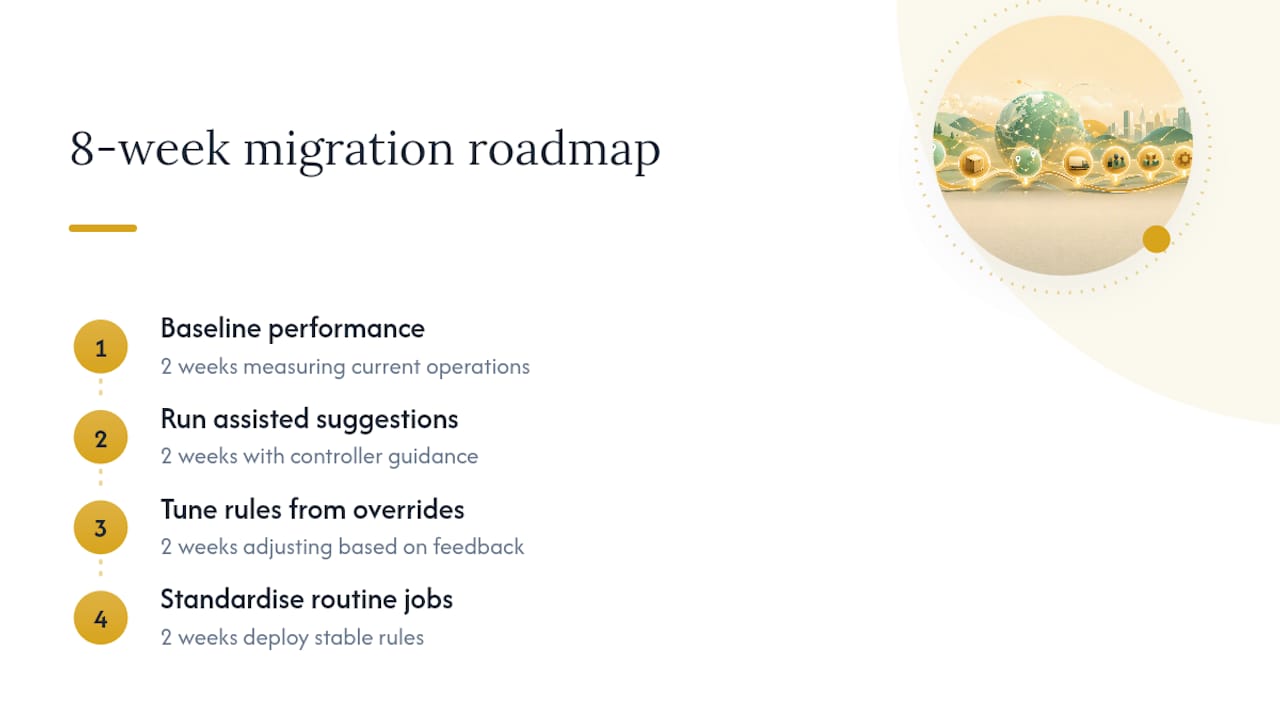
How long does it take to move from manual to rules-based dispatch safely? Around eight weeks: two weeks baselining current performance, two weeks running assisted suggestions, two weeks tuning rules from controller overrides, and two weeks standardising the routine jobs.
Sources
- Emerging optimization problems for distribution in same-day delivery
- Same-day courier dispatch software for UK operators
- How to optimise multi-stop delivery routes — Routella