
Emergency delivery verification is defined as the process of confirming that an urgent shipment has reached the correct recipient, at the correct location, under the required conditions, with a legally defensible record of every handoff. Modern digital proof-of-delivery (ePOD) systems achieve this by capturing GPS coordinates, timestamps, and biometric signatures at the exact point of delivery. Platforms such as carGO Health and Veridas have made this level of documentation standard practice across healthcare, commercial, and time-critical logistics. Understanding how emergency deliveries are verified is no longer optional for businesses. It determines legal liability, regulatory compliance, and whether a disputed delivery can be resolved quickly or dragged through costly proceedings.
What are the key components of the emergency delivery verification process?
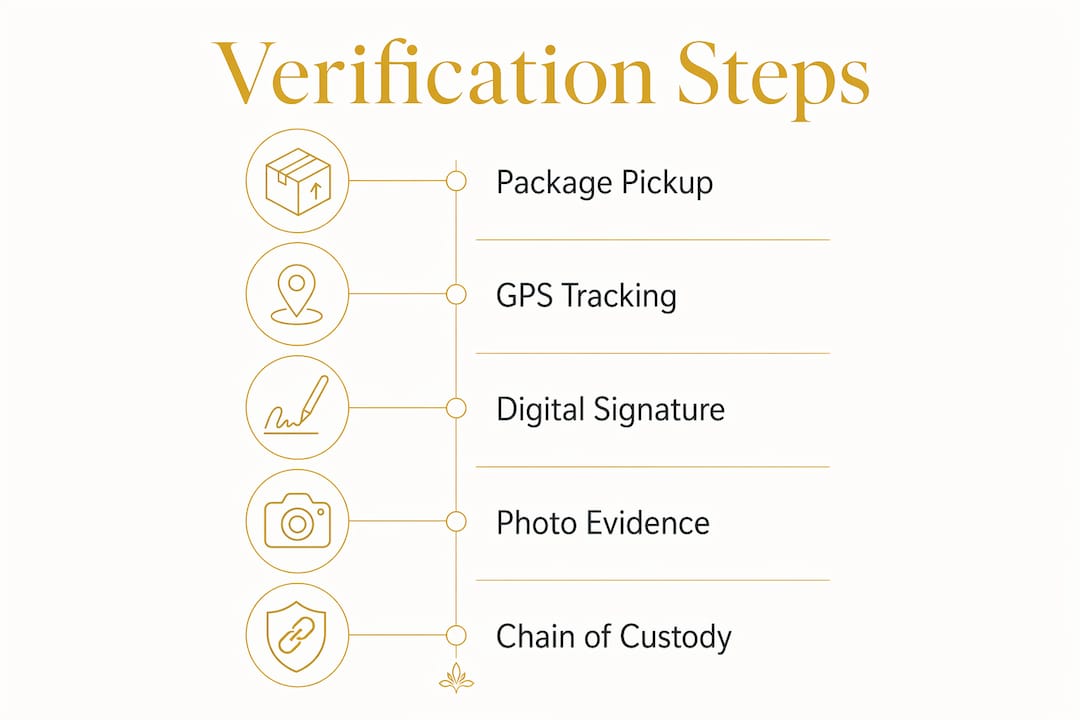
The emergency delivery verification process relies on several distinct data points captured simultaneously at the moment of handover. No single element is sufficient on its own. The combination creates an audit trail that is difficult to dispute.
The core components of a verified emergency delivery are:
- GPS coordinates and geo-fencing. The courier's device records the precise delivery location. Geo-fencing technology prevents a driver from marking a delivery as complete until the device detects they are physically within the defined radius of the destination. This eliminates fraudulent early confirmations.
- Precise timestamps. Every action, from pickup to final handover, is logged with a timestamp synced to GPS clocks. This creates a chronological record that courts and auditors can rely on.
- Recipient verification. The intended recipient confirms receipt through a digital signature, a biometric scan, or both. Biometric verification systems provide irrefutable proof that the correct individual physically accepted the delivery.
- Photographic documentation. Couriers capture images of the parcel at pickup, during transit where required, and at the point of delivery. For deliveries to unmanned locations, photographs of the parcel in situ serve as the primary evidence.
- Courier and recipient identification. Both parties' credentials are logged. This is particularly important in healthcare and pharmaceutical deliveries where authorised personnel requirements apply.
- Environmental data. For cold-chain goods such as medical specimens or temperature-sensitive pharmaceuticals, temperature logs are integrated directly into the delivery record. This links transport conditions to the proof-of-delivery at the point of handover.
Pro Tip: When commissioning an emergency courier for sensitive goods, confirm in advance that the ePOD system captures environmental data alongside location and signature. A delivery record without temperature logs is incomplete for cold-chain compliance.

How do digital ePOD systems compare to traditional paper-based verification?
The shift from paper to digital proof-of-delivery has fundamentally changed what counts as acceptable evidence in emergency logistics. The differences are not cosmetic. They affect legal enforceability, audit speed, and the ability to resolve disputes.
| Factor | Traditional paper-based | Digital ePOD systems |
|---|---|---|
| Signature capture | Handwritten, no identity check | Digital or biometric, identity verified |
| Timestamp accuracy | Manual, prone to error | GPS-synced, automated |
| Location confirmation | None | GPS coordinates with geo-fencing |
| Photographic evidence | Rarely included | Standard at pickup and delivery |
| Chain of custody | Paper trail, easily lost | Electronic, real-time, tamper-evident |
| Legal enforceability | Weak without corroboration | Strong; prima facie legal evidence |
| Audit access | Manual retrieval, slow | Instant digital retrieval |
| Environmental data | Not captured | Integrated for cold-chain goods |
Paper signatures were the industry standard for decades, but they carry significant weaknesses. A handwritten signature offers no location confirmation, no timestamp accuracy, and no way to verify the signer's identity. Digital ePOD systems remove all three gaps simultaneously. Contemporaneous digital records carry significantly more legal weight than retroactive entries made hours or days after delivery. That distinction matters enormously when a delivery is disputed in court or during a regulatory audit. For businesses using courier tracking solutions that include geo-fencing and biometric capture, the move to ePOD is not an upgrade. It is a compliance requirement.
Why is chain of custody critical in emergency deliveries, and how is it verified?
Chain of custody is the documented record of every person who handled a shipment, at every point in its journey, from origin to final recipient. In emergency deliveries, a broken or undocumented chain of custody can invalidate the delivery entirely, particularly in healthcare, legal, and pharmaceutical contexts.
Verifying chain of custody in emergency logistics requires the following at every handoff point:
- Timestamped handover records. Each transfer between personnel is logged with a GPS-synced timestamp and the identity of both the outgoing and incoming handler.
- Anomaly documentation. Documenting minor issues such as scuffed packaging or a broken seal at the point of pickup or handoff protects all parties from later damage claims. These are called anomaly notes, and they are a standard requirement in professional logistics.
- Personnel identification. Every individual who touches the shipment must be identified by name, role, and credential. Unauthorised handoffs are a chain-of-custody breach.
- Geo-fenced workflows. Systems that restrict status updates to verified locations prevent drivers from transferring custody outside the approved delivery zone.
- Exception handling procedures. Auditors flag businesses that lack written procedures for failed delivery attempts or signature refusals. Every exception must be documented contemporaneously, not reconstructed afterwards.
- Regulatory retention. For healthcare logistics, HIPAA and laboratory accreditation standards require transport records to be retained for up to six years. Electronic records satisfy this requirement far more reliably than paper files.
Pro Tip: Build exception handling into your courier brief before dispatch. Specify what the courier must do if the recipient is unavailable, refuses to sign, or if packaging is damaged on arrival. A courier without a documented exception protocol is a liability.
The legal significance of chain of custody extends beyond healthcare. In commercial disputes, a complete chain-of-custody record is the difference between a resolved claim and a protracted legal process. Businesses that treat chain-of-custody documentation as a formality rather than a legal instrument consistently face higher dispute rates. For a deeper look at how emergency courier reliability connects to legal defensibility, the standards are consistent across sectors.
What practical steps should businesses follow to verify emergency deliveries?
Verifying urgent deliveries effectively requires deliberate choices at every stage, from selecting the courier to retaining records after delivery. The following steps reflect best practice across regulated and commercial sectors.
-
Select a courier with certified ePOD technology. Confirm that the courier's system captures GPS coordinates, timestamps, photographs, and digital or biometric signatures as standard. Ask specifically whether the system uses geo-fencing to prevent premature delivery confirmation.
-
Confirm recipient identity requirements in advance. Specify whether the delivery requires a named recipient, a role-based recipient such as a pharmacist or site manager, or whether photographic evidence at an unmanned location is acceptable. Ambiguity at this stage creates disputes later.
-
Insist on photographic proof for all deliveries. Photographs of the parcel at pickup and at the point of delivery are non-negotiable for emergency consignments. For deliveries to secure or unmanned locations, photographs are the primary verification record.
-
Require environmental monitoring for sensitive goods. Cold-chain deliveries must include temperature logs linked to the delivery record. A delivery that arrived at the correct address but at the wrong temperature is a failed delivery in regulatory terms.
-
Maintain contemporaneous exception logs. Any deviation from the planned delivery, including a missed recipient, a refused signature, or damaged packaging, must be recorded at the moment it occurs. Retroactive records carry far less legal weight.
-
Verify courier credentials and compliance certifications. For healthcare, pharmaceutical, or high-value commercial deliveries, confirm that the courier holds relevant accreditations. Credential verification is part of the chain-of-custody record.
-
Retain all delivery records in a retrievable digital format. Store ePOD records in a system that allows rapid retrieval for audits, insurance claims, or legal proceedings. Paper archives do not meet this standard for regulated industries.
Businesses that follow these steps consistently report fewer disputes and faster resolution when issues do arise. The common mistakes in emergency delivery that create the most damage are almost always procedural gaps rather than courier failures.
Key takeaways
Emergency deliveries are verified through digital ePOD systems that combine GPS data, biometric signatures, photographic evidence, and contemporaneous timestamps to create a legally defensible chain-of-custody record.
| Point | Details |
|---|---|
| ePOD systems are the standard | Digital proof-of-delivery captures GPS, photos, and biometric signatures simultaneously at handover. |
| Chain of custody requires anomaly notes | Document even minor packaging issues at pickup to prevent later damage disputes. |
| Geo-fencing prevents fraud | Systems block delivery confirmation until the courier is physically within the defined delivery radius. |
| Retention periods matter | Healthcare logistics records must be kept for up to six years under HIPAA and laboratory accreditation standards. |
| Exception handling must be pre-planned | Written procedures for failed attempts and refused signatures are required for compliance audits. |
The verification gap most businesses still ignore
The industry has made enormous progress on the technology side of delivery verification. GPS, biometrics, and ePOD platforms are widely available and increasingly affordable. What I see businesses consistently underestimate is the human side of the process, specifically exception handling.
A courier equipped with a state-of-the-art ePOD system but no documented procedure for a refused signature is still a liability. The technology captures what happens. The procedure determines what should happen. Those two things must align before the vehicle leaves the depot.
The other area I think deserves more attention is the integration of environmental data. Temperature monitoring for cold-chain deliveries is increasingly standard in healthcare logistics, but commercial sectors handling food, chemicals, or specialist materials often treat it as optional. It is not optional if the goods are temperature-sensitive. A delivery record without environmental data is incomplete, and in a dispute, incomplete records favour the claimant.
Blockchain-based delivery records are the next significant development in this space. Immutable, distributed records would eliminate the remaining vulnerabilities in current ePOD systems, particularly around retroactive data manipulation. The technology is not yet mainstream in UK courier operations, but the direction is clear. Businesses that build verification discipline now will adapt to blockchain records far more easily than those still relying on paper.
The practical recommendation is straightforward. Treat verification as a pre-dispatch conversation, not a post-delivery report. Agree on the verification standard, the exception protocol, and the retention format before the courier collects the consignment. That single habit eliminates the majority of disputes I have seen in emergency logistics.
— Ayomide
Verified emergency deliveries with Sddbyaba
Sddbyaba operates nationwide same-day courier services built for time-critical consignments across healthcare, commercial, construction, and manufacturing sectors. Every emergency delivery is supported by digital proof-of-delivery processes that capture GPS location, timestamps, photographic evidence, and recipient confirmation at the point of handover.

For businesses that need a dedicated courier service with verified chain-of-custody documentation, Sddbyaba provides a fleet ranging from motorcycle couriers to 26-tonne vehicles, covering the full spectrum of urgent logistics requirements. Whether the consignment is a single parcel or a multi-vehicle freight movement, Sddbyaba delivers with the documentation to prove it. Contact Sddbyaba to discuss your emergency delivery verification requirements and receive a same-day quote.
FAQ
What is proof of delivery in emergency logistics?
Proof of delivery (POD) is the documented confirmation that a shipment reached the intended recipient. In emergency logistics, this takes the form of a digital ePOD record combining GPS coordinates, timestamps, photographs, and a digital or biometric signature.
How do digital signatures verify emergency deliveries?
Digital signatures capture the recipient's identity at the point of handover and link it to a GPS-stamped, timestamped record. Biometric systems go further by confirming the physical identity of the signer, making the record legally irrefutable.
What is chain of custody and why does it matter?
Chain of custody is the documented record of every person who handled a shipment from origin to delivery. A complete chain-of-custody record is required for legal compliance in healthcare and pharmaceutical logistics, and it is the primary evidence in delivery disputes.
How long must emergency delivery records be retained?
For healthcare logistics, HIPAA and laboratory accreditation standards such as CLIA and CAP require transport records to be retained for up to six years. Commercial sectors should retain records for the duration of any applicable contractual or statutory limitation period.
What happens if an emergency delivery cannot be completed?
Any failed delivery attempt must be documented contemporaneously with a timestamp, location record, and reason for failure. Auditors treat the absence of documented exception procedures as a compliance risk, and retroactive records carry significantly less legal weight than real-time logs.