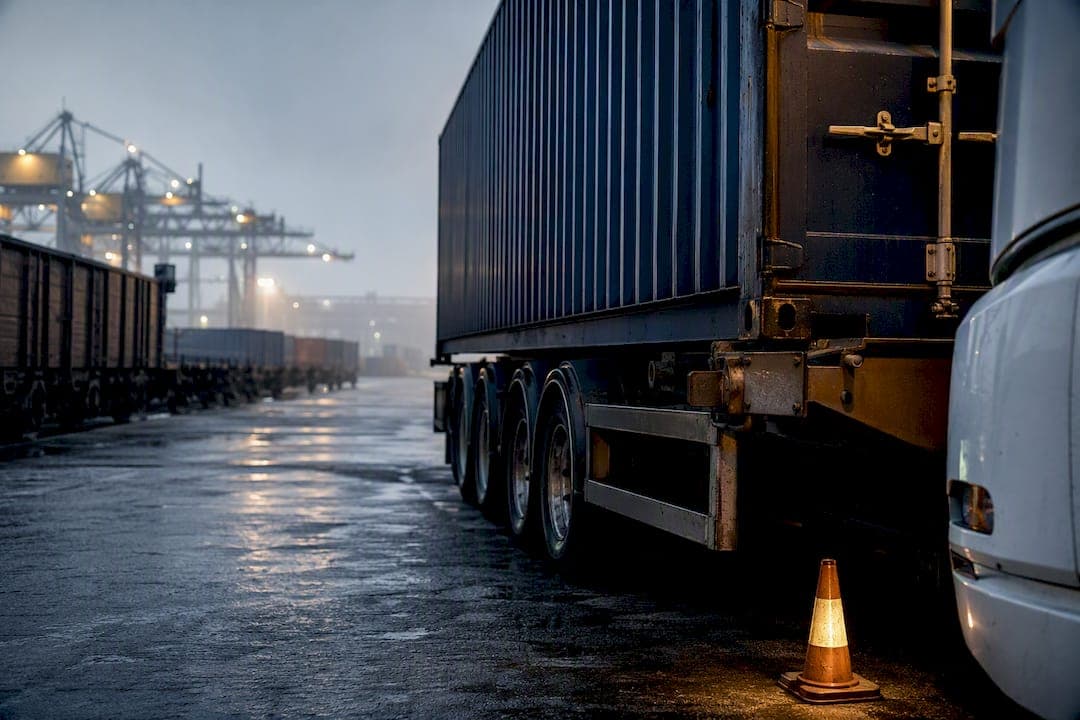
Container haulage is the road and rail movement of shipping containers between ports, rail terminals, depots and delivery points. For UK businesses moving bulk or containerised freight, it remains the standard choice because it keeps goods sealed in one box from origin to final destination, cutting handling and reducing damage risk along the way.
TL;DR:
- Port congestion significantly delays container arrivals, disrupting inland collection windows and increasing the risk of detention and demurrage charges.
- Short-port drayage is cost-effective for local transfers, while long-haul and intermodal moves involve higher costs, especially with added waiting time or delays.
- Accurately declaring container weight and choosing flexible options like drop-and-collect can prevent costly delays and hours-based charges.
- Reliable providers with established terminal relationships and clear communication reduce risk, but delays stem mainly from congestion, booking inefficiencies, and rail route restrictions.
- UK freight costs vary widely based on distance, container size, and timing, with early booking and consolidation offering potential savings and scheduling certainty.
Table of Contents
- How does container haulage work? The process explained
- What are the main types of container haulage service?
- Container types and sizes: what UK businesses need to know
- What are the benefits of container haulage for UK businesses?
- What's included in a container haulage quote?
- How much does container haulage cost in the UK?
- How do you choose a container haulage provider?
- What UK-specific challenges affect container haulage?
- What exactly counts as container haulage?
- A haulier's view: what actually slows containers down
- How Sddbyaba supports container haulage across the UK
- Sources
How does container haulage work? The process explained
Booking starts the process. You, or your freight forwarder, provide the haulier with the container number, terminal booking reference and delivery address, while the shipping line or port issues the release note confirming the container is free to collect. Documentation matters here: a missing container release or an incorrect delivery reference is the single most common cause of a wasted terminal slot.
The stages that follow are fairly consistent, whatever the provider:
- Booking and manifest checks — the haulier confirms container availability, weight declaration and any customs holds before scheduling collection.
- Terminal collection — the driver arrives within a booked access slot, presents documentation, and the terminal allocates a chassis (or the container is already chassis-mounted) for lift-on.
- Road movement — the vehicle carries the container to its destination, with driving hours governed by standard UK drivers' hours rules and any waiting time tracked against the quote's free allowance.
- Delivery and unloading — the consignee unloads or the driver waits for a live unload, then signs the delivery note, which becomes the reference point for any dispute.
- Empty return — the empty container goes back to a nominated terminal or depot, and this leg is where detention (holding the container too long) and demurrage (leaving it at the terminal past the free period) charges tend to surface if timings slip.
Port congestion is a genuine factor in how smoothly this runs. Academic analysis has identified port congestion as a major driver of containership schedule unreliability, and that unreliability travels straight down the supply chain into inland collection windows. A container that arrives late at port pushes every subsequent booking, chassis allocation and delivery slot back with it. The World Shipping Council's description of the container journey confirms just how many discrete handoffs exist between vessel discharge and final delivery, each one a potential delay point.
What are the main types of container haulage service?
Not every container move needs the same service. Matching the type to your shipment saves money and avoids unnecessary waiting charges.
- Short-port drayage moves a container a short distance from port or terminal to a nearby depot, often the first or last leg of a longer journey.
- Long-haul domestic trunking carries a container across the country by road, typically for businesses without a rail-connected site nearby.
- Intermodal moves combine rail and road, using rail for the long middle distance and road haulage for the first and last mile, which suits high-volume routes between major UK ports and inland terminals.
- Drop-and-collect leaves the container at your site for you to unload at your own pace, then the haulier returns later to collect the empty box.
- Wait-and-load keeps the driver and vehicle on-site while you unload immediately, which is faster but ties up the vehicle and usually costs more per hour beyond a free allowance.
- Specialist moves cover refrigerated (reefer) containers needing power connections en route, ADR-certified transport for hazardous goods, and oversized or flat-rack loads requiring escort or permits.
Pro Tip: If your warehouse can't guarantee same-day unloading, choose drop-and-collect even if the day rate looks slightly higher. Wait-and-load charges accrue in hourly blocks, and a single delayed forklift operator can turn a cheap quote into an expensive one.
Container types and sizes: what UK businesses need to know
Getting the container specification right at booking stage avoids compatibility problems further down the line, particularly on rail legs.
- 20ft standard container — roughly 1 TEU (twenty-foot equivalent unit), the base measure used across the industry for capacity and port statistics.
- 40ft standard container — equivalent to 1 FEU (forty-foot equivalent unit), or 2 TEU, and the most common box for general cargo.
- Hi-cube containers — taller versions of the 40ft box, offering extra volume for lighter, bulkier goods, but not always compatible with every rail route.
- Reefer containers — insulated and powered for temperature-controlled goods such as pharmaceuticals or fresh produce.
- Open-top and flat-rack containers — designed for oversized, awkward-shaped or overheight cargo that won't fit through a standard door opening.
Around 90% of the world's non-bulk cargo now moves in standardised intermodal containers, which is precisely why TEU and FEU have become the universal shorthand for capacity across shipping lines, ports and hauliers. That same standard relies on ISO corner castings and twistlocks, the fittings that let cranes and trucks lift and secure a container safely across every mode it travels on.
UK rail loading gauges are worth checking before you specify a hi-cube box for an intermodal leg. Some inland rail routes cannot clear the extra height, which means a hi-cube container booked for rail carriage can end up needing a road-only substitute at short notice. On road moves, payload and gross weight limits follow standard UK haulage rules, so declaring an accurate container weight at booking avoids problems at the weighbridge.
What are the benefits of container haulage for UK businesses?
Containerisation earns its place in UK supply chains because it solves several problems at once rather than trading one for another.
- Fewer handlings, less damage — cargo stays sealed in the same box from factory to final delivery, which is the core reason containerised freight suffers less damage and pilferage than loose-loaded alternatives.
- Economies of scale — moving a full container load is almost always cheaper per unit of cargo than multiple smaller consignments covering the same volume.
- Intermodal efficiency — shifting the long middle leg onto rail reduces road mileage and emissions on high-volume corridors, while keeping road haulage for the flexible first and last mile.
- Predictable planning — standard container dimensions make warehouse slotting, dock scheduling and stock forecasting far more reliable than mixed, non-standardised freight.
Roughly nine in ten non-bulk goods worldwide now travel this way, a scale that has pushed containerisation into the default choice for anything beyond small parcel volumes. The efficiency gain compounds the moment a business has more than one container to move regularly, because the fixed costs of booking, documentation and terminal access get spread across a bigger load.
What's included in a container haulage quote?
Reading a quote line by line matters more than comparing headline totals, because the cheapest-looking figure often hides the narrowest inclusions.
- Usually included: terminal collection, the road line-haul itself, and a basic waiting allowance (commonly 30 to 60 minutes at each end).
- Common extras to check for: waiting time beyond the free allowance, failed or re-delivery attempts, storage at a depot if the container can't be delivered immediately, tail-lift hire for kerbside unloading, and lift-on/lift-off charges where a crane rather than a chassis system is needed.
- Customs and documentation fees apply when the move involves import or export paperwork, and these sit outside most standard haulage quotes unless explicitly stated.
Ask any provider to itemise these separately rather than quoting a single bundled figure. It's the only way to compare two quotes fairly when one includes an hour of waiting time and the other charges from minute one.
How much does container haulage cost in the UK?
Container haulage pricing in the UK varies enormously depending on distance, container size, terminal conditions and how much flexibility you can offer on timing. Short-port drayage between a nearby terminal and a local depot tends to sit at the lower end of the range, while longer domestic trunking across several hundred miles costs proportionately more. Industry pricing pages routinely quote figures from a few hundred pounds for short drayage up to well over a thousand pounds for longer trunking moves, though these should always be treated as indicative rather than fixed, since port fees, fuel surcharges and container size shift the number considerably.
Several factors move the price up or down:
- Distance and route — longer moves cost more, obviously, but so do routes through congested ports or restricted urban delivery windows.
- Container size — a 40ft box typically costs more to haul than a 20ft one, though not always double, since fuel and driver time don't scale perfectly with box length.
- Waiting time — every hour beyond the free allowance adds a day-rate or hourly charge, and this is where wait-and-load quotes can escalate fast.
- Port and terminal fees — some terminals charge access or infrastructure fees passed straight through to the haulage bill.
- Urgency — same-day or out-of-hours collection commands a premium over a standard next-day slot.
Pricing models generally fall into three camps: per-container flat rates for common routes, per-mile rates for irregular or long-distance moves, and day-rates for wait-and-load work where the vehicle is effectively hired by the hour.
Pro Tip: Book collection slots as early in the week as you can. Friday afternoon and Monday morning are the two busiest windows at most UK terminals, and haulier availability tightens noticeably around them, often pushing urgent bookings into premium pricing.
You can reduce costs meaningfully by consolidating multiple smaller loads into fewer full containers, staying flexible on collection dates rather than demanding a fixed hour, and booking ahead of time instead of calling for same-day collection whenever your operation allows it.
How do you choose a container haulage provider?
A good provider shows their competence before you even ask a question, in how clearly they answer the first one.
- Check terminal experience. A haulier with an established account and direct terminal access typically clears containers faster than one booking through a general broker each time.
- Confirm fleet suitability. Ask specifically whether they run vehicles capable of handling your container size and weight, and whether ADR certification is available if you're moving hazardous goods.
- Verify insurance cover. Ask for confirmation of goods-in-transit and public liability insurance levels before booking, not after a problem arises.
- Ask about UK coverage. Confirm they can genuinely reach your delivery postcode with the right vehicle, rather than subcontracting the final leg to an unknown third party.
- Get clarity on service levels. Ask what happens if the vessel is delayed, what the waiting allowance actually covers, and how empty returns are scheduled.
Red flags worth taking seriously include vague answers about which terminals they work at regularly, reluctance to itemise a quote, and no clear answer on who covers detention charges if a delay isn't your fault. A provider who volunteers this information unprompted is usually the one who has dealt with it before.
What UK-specific challenges affect container haulage?
Three structural issues shape almost every container move in the UK, and none of them are going away soon.
- Port congestion remains a persistent source of schedule unreliability, with research identifying it as one of the biggest contributors to inland delay once a container is discharged from the vessel.
- Terminal booking windows and security processes mean drivers arriving outside an allocated slot can face long queues or turned-away collections, particularly at the UK's busiest deep-sea ports.
- Rail loading-gauge limits restrict which routes can carry hi-cube containers, occasionally forcing a switch to road-only carriage at short notice.
Mitigation is largely practical rather than technical. Building buffer time into delivery promises, using a haulier with an established terminal relationship, and securing pre-booked collection slots rather than relying on ad hoc access all reduce exposure to these delays. Government guidance on the UK freight transport system points to pre-booked slots and direct terminal access accounts as genuinely effective ways to cut queuing and chassis delays, rather than simply hoping congestion clears on its own.
What exactly counts as container haulage?
Container haulage covers the road and rail transport of standardised shipping containers, but the scope is narrower than "container shipping" as a whole. Shipping is the entire door-to-door journey, including the ocean or short-sea leg by vessel. Haulage is specifically the inland portion: moving a container by lorry or rail wagon between a port, rail terminal, depot or customer site.
That distinction matters when you're getting quotes, because a shipping line's quote covers the sea leg and often the port-to-terminal transfer, while a haulier's quote covers everything from terminal collection onwards. Confusing the two is a common reason businesses end up with a gap in coverage between vessel discharge and final delivery.
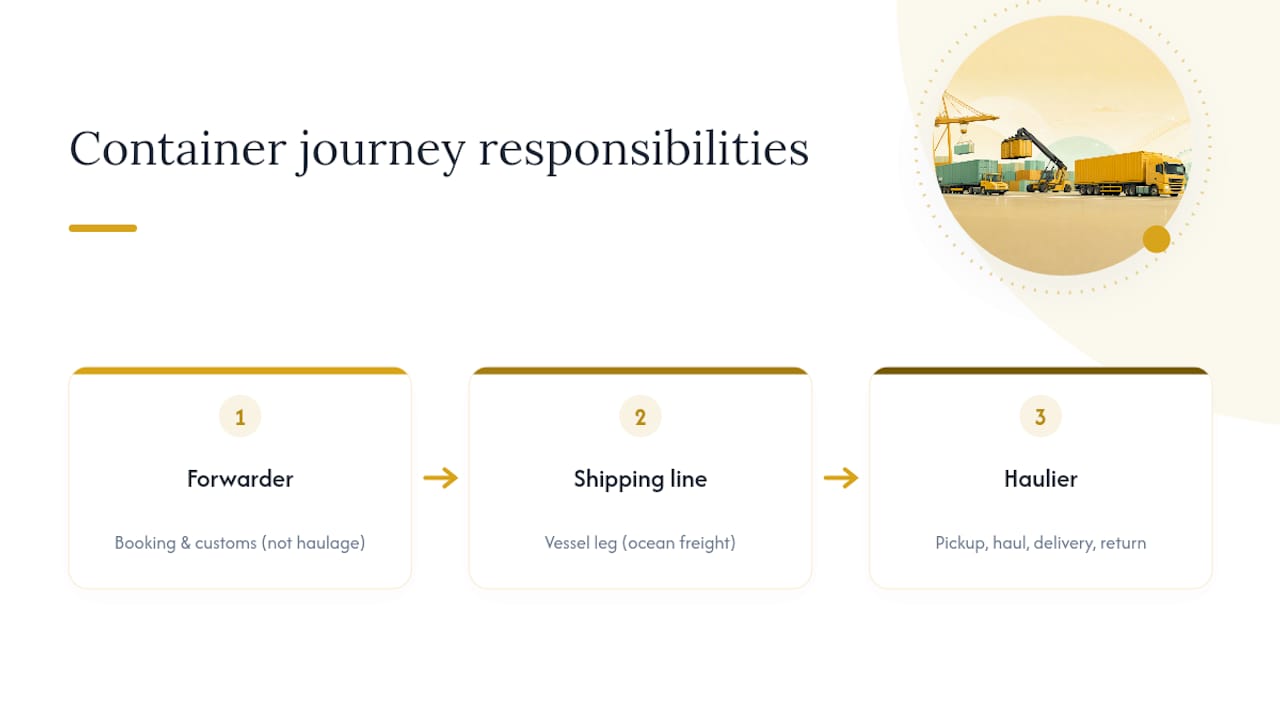
Within haulage itself, the scope includes booking coordination, terminal collection, the road or rail line-haul, delivery and unloading, and the empty container return. It does not typically include customs clearance, which sits with a freight forwarder or customs broker, nor does it include the ocean freight contract itself. Businesses moving containers regularly tend to deal with several parties across a single shipment: a forwarder for booking and customs, a shipping line for the vessel leg, and a haulier for everything on UK roads and rail. Understanding where each party's responsibility starts and ends is what actually prevents disputes when something goes wrong mid-journey.
A haulier's view: what actually slows containers down
The fastest container collections happen when the paperwork is right before the driver leaves the yard, not after they arrive at the gate. Booking references, weight declarations and delivery contact details sorted in advance save more time than any amount of driver skill at the terminal barrier.
The most common customer mistake is treating the free waiting allowance as a formality rather than a real constraint. A warehouse that can't guarantee unloading within that window should book drop-and-collect every time, whatever the day rate looks like on paper.
Terminal relationships count for more than most businesses expect. A haulier who books that same terminal weekly tends to know which access slots run smoothly and which routinely back up.
— Ayomide
How Sddbyaba supports container haulage across the UK
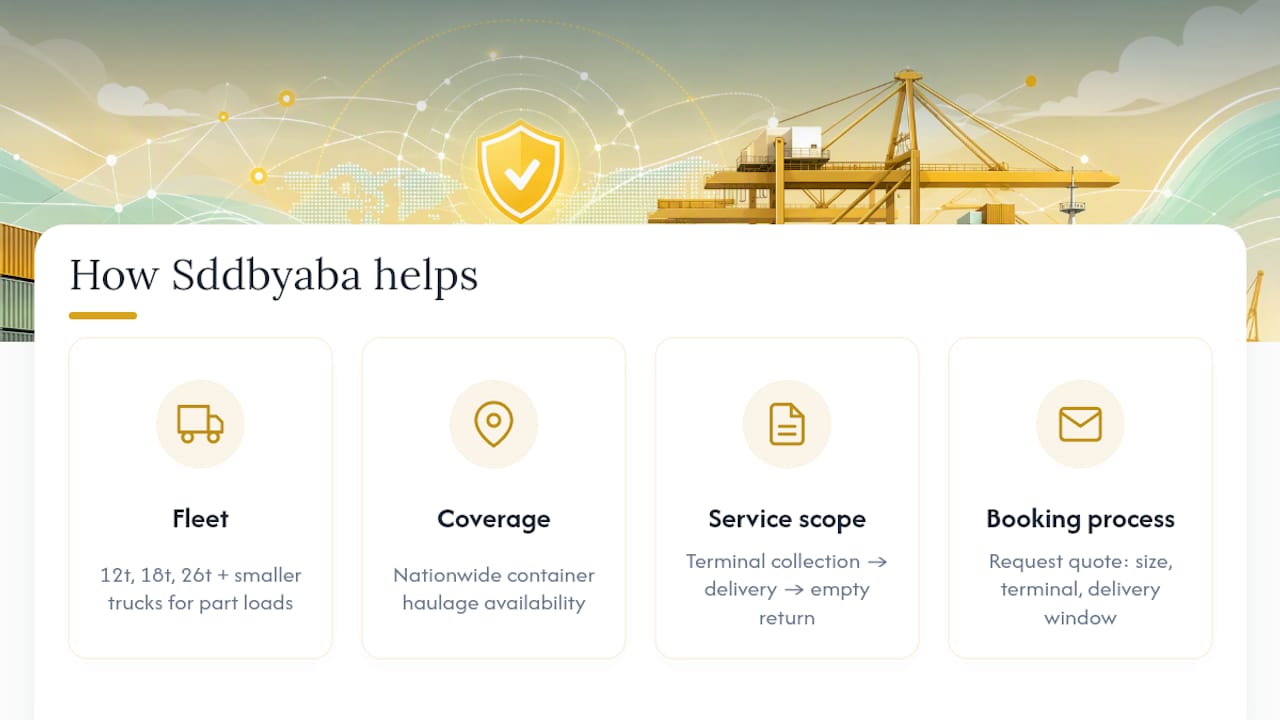
A reliable container haulage provider offers direct access to container capacity without the layered subcontracting that slows so many haulage bookings down. Our fleet spans 12 tonne, 18 tonne and 26 tonne freight vehicles suited to full container loads, alongside smaller trucks for lighter or part-container moves, all coordinated with clear, direct communication rather than a broker chain.
This matches the key verification points: nationwide coverage, a fleet matched to container sizes, and a provider who answers questions about waiting allowances and service levels without hedging. Our freight haulage service covers terminal collection through to final delivery and empty return, with the same responsiveness we apply to urgent same-day work. If a shipment is time-critical, our guide on avoiding common time-critical delivery pitfalls is worth reading alongside your booking.
If you're planning a container move, whether it's a single collection or a recurring route, request a quote through our main enquiry page and tell us the container size, terminal and delivery window. We'll confirm fleet availability and pricing directly, with no unnecessary middle steps.
Sources
For deeper background, the DfT's freight transport system overview covers modal choices in detail, while the World Shipping Council's container shipping explainer and Freightos's container freight guide both offer useful process context for anyone new to the topic.
- Understanding the freight transport system (DfT)
- Ocean container transport in global supply chains: Overview and research opportunities
- Container Shipping 101: Ultimate Guide to Container Freight | Freightos
- How container shipping works | World Shipping Council
- Intermodal container (Wikipedia)