
The standard legal overall length for an articulated lorry in the UK is generally around sixteen and a half metres, with recognised exceptions allowing some longer semi-trailers under specific conditions. Standard width is generally two point five five metres, increasing to about two point six metres for refrigerated bodies. There is no statutory maximum height, but every operator must check bridge clearances on the route and display cab height once the vehicle exceeds 3.0 metres.
TL;DR:
- UK articulated lorries are typically limited to 16.5 meters in overall length, with allowances up to 18.55 meters for approved low-loader and longer semi-trailers.
- Load projections and extensions beyond standard dimensions require marker boards, lighting, and possibly escorts, with route-planning checks critical to avoid bridge strikes or infrastructure damage.
- Proper route preparation involves measuring actual vehicle height, verifying bridge clearance, and documenting checks, as non-compliance risks heavy fines and operator license repercussions.
- EU dimension rules largely mirror UK standards, but operators crossing borders must verify specific country limits, especially for trailers at the upper length or weight levels.
Table of Contents
- What are the legal artic lorry dimensions UK operators must know?
- How does UK law define and limit artic length?
- What are the width and height rules for UK artics?
- What GVW and axle limits apply to articulated combinations?
- Why does trailer geometry limit manoeuvrability?
- What are the rules on load projections and marker boards?
- How should operators plan routes to avoid bridge strikes?
- How should artic lorries secure and distribute loads within legal dimensions?
- Do EU dimension rules differ from UK artic regulations?
- How do artic dimensions affect parking and loading bay design?
- What penalties apply for dimension violations in the UK?
- What do operators get wrong about artic dimensions?
- How SDD by ABA handles compliant artic movements
- Sources
What are the legal artic lorry dimensions UK operators must know?
Every figure below comes from the Construction and Use Regulations or GOV.UK guidance, and every one of them should sit on the wall of a transport office, not buried in a compliance folder nobody opens until something goes wrong.
| Dimension | Legal limit | Notes |
|---|---|---|
| Standard overall length (artic) | 16.5 m | Baseline for most articulated combinations |
| Container/swap body allowance | 16.65 m | Applies to specific ISO container and swap body configurations |
| Low-loader semi-trailer | 18.0 m | For designated low-loader trailer types |
| Longer semi-trailer (LST) | Up to 18.55 m | Subject to operator authorisation and specific trailer design |
| Semi-trailer length (typical) | 12.0 m to 13.6 m | Standard curtainsider and box trailer range |
| Standard trailer width | 2.55 m | Applies to the vast majority of general haulage trailers |
| Refrigerated trailer width | 2.6 m | Extra allowance for insulated bodywork |
| Height | No statutory maximum | Cab must display height once over 3.0 m |
These figures are set out in the Road Vehicles (Construction and Use) Regulations and confirmed in Gov on maximum vehicle lengths. Treat the table as a starting reference, not the final word. Trailer type, axle configuration, and cargo all shift what applies to a specific job.
How does UK law define and limit artic length?
"Overall length" under the Construction and Use Regulations means the full measurement from the front of the tractor unit to the rear of the trailer, including any rigid overhang but excluding certain fittings like mirrors. That distinction matters when a driver reports a trailer as "13.6 metre" and the combination still comes out at 16.4 metres once the tractor is added.
The 16.5 metre standard applies to most articulated combinations running general freight. Beyond that baseline, three specific allowances exist:
- 16.65 m for combinations carrying ISO containers or swap bodies of a defined type.
- 18.0 m for low-loader semi-trailers, where the reduced deck height accounts for the extra length.
- 18.55 m for longer semi-trailers (LSTs), authorised under a dedicated scheme with additional design and driver training requirements.
None of these exceptions are automatic. A driver cannot simply hitch a longer trailer and assume compliance; the trailer type and its registration need to match the allowance being claimed.
Trailer geometry adds a second layer of constraint that catches out operators focused only on the headline figure. The Construction and Use Regulations cap the kingpin-to-rear measurement at 12.0 metres and limit forward swing radius from the kingpin to 2.040 metres. Both rules exist to control how far a trailer's body can extend and swing during a turn, and both directly shape how much usable load space a trailer design can offer within the legal envelope.
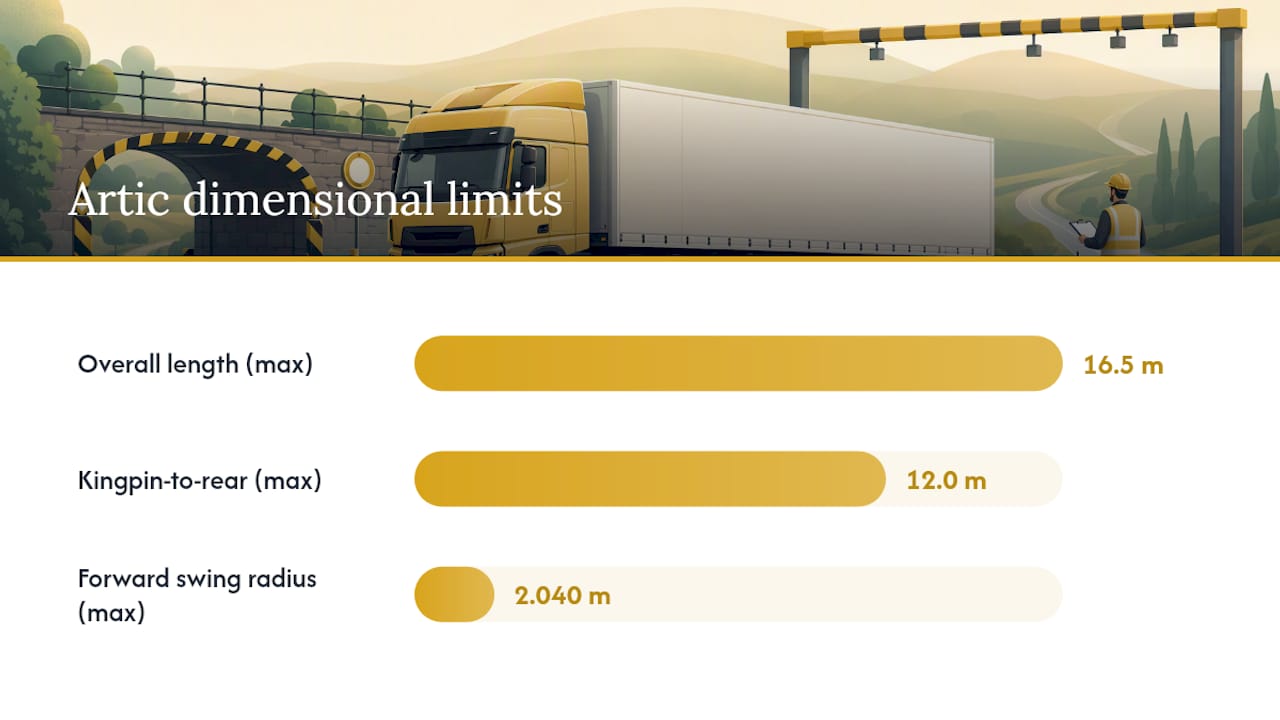
For operators choosing between trailer types, this geometry often matters more than the raw length figure. A curtainsider optimised for kingpin position can carry noticeably more usable deck than a poorly designed trailer of identical overall length, and it will behave better reversing into tight yards.
What are the width and height rules for UK artics?
Width restrictions are simpler than length, but exceptions apply especially for temperature-controlled trailers.
- Standard trailer width is generally capped near two point five five metres.
- Refrigerated and insulated trailers benefit from a slightly larger width allowance, reflecting insulation needs, as confirmed by industry guidance on legal trailer dimensions.
- Loads that genuinely exceed standard width need markings, and in more extreme cases, notification or escort arrangements depending on the extent of the overhang.
Height is where the UK diverges sharply from what many drivers assume. There is no statutory maximum height for an articulated lorry in this country. That surprises plenty of newer operators, who expect a fixed number similar to the length and width rules.
Height limit context: while no legal ceiling exists, practical clearance on most UK motorways and A-roads sits around 4.9 to 5.03 metres, based on typical infrastructure design referenced in analysis of longer heavier vehicle standards. Anything built to that height still needs every bridge on the route checked individually, because older or rural crossings drop well below it.
The absence of a legal cap does not remove the operational duty to plan around it. Two obligations follow from this:
- The vehicle's actual height must be checked and displayed in the cab whenever it exceeds 3.0 metres, so the driver has a constant visual reference.
- Route planning must verify every bridge, tunnel and low structure on the journey, because "legal" and "passable" are two entirely different questions on a UK road.
What GVW and axle limits apply to articulated combinations?
Weight limits depend almost entirely on axle count and suspension type, and getting this wrong is one of the most common ways operators land in trouble with enforcement checks.
- Five-axle articulated combinations are commonly limited to 40 tonnes gross vehicle weight, the figure most general haulage fleets run to.
- Six-axle combinations fitted with road-friendly suspension can be permitted up to 44 tonnes, reflecting the reduced road wear that better suspension design delivers, as set out in operator guidance on articulated lorry weight and dimensions.
- Individual axle limits still apply within that overall figure. Overloading one axle while staying under the total GVW is still an offence, and it's a far more common mistake than exceeding the combination weight outright.
The ministry plate, sometimes still referred to by its VTG6 reference, is fitted to every trailer and states the maximum permitted weights for that specific unit, both gross and per axle. Dispatchers should treat that plate as gospel rather than relying on a generic fleet-wide figure, because trailers of the same model year can carry different plated limits depending on modifications or specification changes. Our own guidance on axle weight limits and load distribution covers how to read plated data correctly when briefing a driver.
Pro Tip: Weigh loaded trailers before the first run on any new contract, even if the paperwork says the cargo should fit within plated limits comfortably. Uneven load distribution catches out more fleets than genuine overloading does.
Why does trailer geometry limit manoeuvrability?
Kingpin position does more than set legal length. It determines how a trailer turns, and that has direct consequences for which sites a vehicle can actually access.
- A trailer with the kingpin set further forward relative to the axle group increases the swing radius during tight turns, which can make reversing into constrained yards far harder even when the overall length is identical to a competitor's trailer.
- Standard articulated combinations typically need a turning envelope well beyond what a rigid vehicle requires, which is why some older industrial sites and rural delivery points simply can't take a full-size artic.
- Loading docks designed decades ago, before today's trailer lengths became standard, often have approach angles too tight for an 18.55 metre LST even where the road access itself is fine.
- Choosing a shorter or low-loader trailer for a specific job isn't a compromise. On constrained sites, it's frequently the only combination that will physically fit.
Fleet planners who match trailer type to destination, rather than defaulting to the largest legal trailer available, avoid a significant share of the failed-delivery callbacks that plague general haulage. A driver arriving at a site they cannot physically manoeuvre into wastes hours and often damages either the vehicle or the site infrastructure trying anyway.
What are the rules on load projections and marker boards?
Cargo that extends beyond the trailer body brings its own set of legal requirements, separate from the vehicle's own dimensions.
- Rear projections beyond a defined threshold require marker boards, and beyond a further threshold, additional lighting or reflective marking.
- Side projections that widen the effective load beyond standard width limits need clear marking and, in some cases, prior notification depending on the extent.
- Drivers carrying projecting loads must fit the correct marker boards before departure, not en route, and check that lighting remains visible in low light and adverse weather.
- Escorts become necessary for genuinely oversized projections, particularly on routes with roundabouts or junctions where the extra length changes swept path significantly.
Liability for an unmarked projection or an infrastructure strike sits squarely with the operator and driver, not just the haulage contract's end client. Insurance disputes following bridge strikes routinely turn on whether marking and route checks were properly documented before departure, which makes the paperwork side of this as important as the physical marker board itself.
How should operators plan routes to avoid bridge strikes?
A workable pre-departure routine removes most of the risk that dimensions and weight regulations exist to manage. This is the checklist worth building into every dispatch process, not just the ones carrying obviously oversized loads.
- Measure loaded height on the yard, not from the trailer specification sheet, because cargo, sheeting and roof-mounted equipment all add to the figure printed on the plate.
- Cross-check every bridge on the route against official height data rather than satnav estimates, since consumer navigation systems are not reliable for HGV clearance.
- Identify local restrictions beyond height, including weight-restricted bridges and width pinch points on the specific route being driven that day.
- Record the checks made before departure, including who verified them and against what source, so there's a paper trail if a dispute arises later.
- Brief the driver on the exact figures for that vehicle and load, not a generic fleet average, and confirm the cab height display matches what was measured.
Documentation to carry includes the ministry plate details, load height confirmation, and any marker board or escort paperwork relevant to that specific job. Vehicle selection for artic movements starts with matching trailer type and dimensions to the site and route before a booking is confirmed, rather than assigning whatever unit happens to be free. That sequencing, checking access and clearance before dispatch rather than after, is what keeps a route-planning checklist from becoming a box-ticking exercise nobody actually reads.
Pro Tip: Keep a running log of known problem bridges and awkward site access points by postcode. Once your fleet has driven a route, that local knowledge is worth more than any generic clearance database.
For site access risks that extend beyond the vehicle itself, such as security around loading and unloading, an insurer-ready site checklist covering CDM compliance offers a useful cross-check for construction-sector deliveries specifically.
How should artic lorries secure and distribute loads within legal dimensions?
Load security rules interact directly with the trailer dimensions covered above. Cargo that shifts inside a legally compliant trailer can turn a road-legal vehicle into a genuine hazard, and enforcement officers treat securing failures with the same seriousness as a length or weight breach.
Weight distribution across the trailer bed determines axle loading, which ties straight back to the plated limits discussed earlier. A load concentrated too far forward or rearward can put one axle group over its individual limit even when the combination's total weight sits comfortably under 40 or 44 tonnes. Distributing cargo evenly along the 12.0 metre trailer bed, rather than stacking heavy items at one end for loading convenience, keeps individual axle readings within plate limits.

Securing methods need to match both the cargo and the trailer's dimensional constraints. Curtainsiders with standard 2.55 metre internal width offer less lashing flexibility than flatbeds, so ratchet straps and load bars need positioning that accounts for the narrower working space. Refrigerated trailers, with their 2.6 metre width but reduced height clearance inside due to insulation, often need cargo stacked lower than a standard dry box would allow.
Rear and side projections beyond the trailer body, discussed earlier in the marking rules, also count against the vehicle's legal footprint for turning and swept path purposes. A load projecting even 300mm beyond the trailer effectively changes the vehicle's manoeuvring envelope on tight site access, regardless of whether marker boards make it legal to travel.
Do EU dimension rules differ from UK artic regulations?
Operators running routes into the EU need to check dimensions against a separate framework, because UK domestic rules and EU vehicle regulation have diverged since Brexit, even though many figures still look similar on paper.
EU vehicle dimension rules, set out in retained and harmonised EU regulation, broadly mirror the UK's 16.5 metre standard for articulated combinations and the 2.55 metre width limit, which is unsurprising given the shared origin of both frameworks. Where the divergence matters most is in the exceptions. The UK's LST scheme, permitting up to 18.55 metres, has no direct EU equivalent recognised across all member states, meaning a trailer legally running at that length domestically may not be accepted for continental haulage without modification or a different unit altogether.
Weight limits present a similar trap. Some EU countries apply different maximum permitted weights for six-axle combinations than the UK's 44 tonne allowance, and road-friendly suspension requirements aren't always assessed identically at the border. Height rules also diverge in practice, since several European countries do apply statutory maximum heights, unlike the UK's clearance-based approach.
Operators planning cross-Channel or wider European runs should treat every dimension figure as a UK-only baseline and verify the destination country's own limits before booking the job, rather than assuming reciprocity. A trailer built to maximise the UK's LST allowance is, in many cases, the wrong choice for a vehicle that regularly crosses into Europe.
How do artic dimensions affect parking and loading bay design?
Loading bay design across the UK has had to catch up with articulated lorry dimensions that have grown steadily over recent decades, and a significant number of older sites simply weren't built for today's standard trailer lengths.
A bay designed for a 12 metre trailer struggles to accommodate an 18.55 metre LST combination attempting to reverse in at the same angle. The approach geometry that worked for shorter combinations often leaves no margin for the wider swing radius that longer trailers require, which is precisely the manoeuvrability constraint covered earlier in relation to kingpin position.
Modern distribution centres and retail parks increasingly design loading bays around the full legal envelope, with deeper approach lanes and wider turning circles built in from the outset. Older industrial estates and high street commercial premises rarely have that luxury, which is why route planners frequently find that the legally largest trailer isn't the practically deliverable one for a given address.
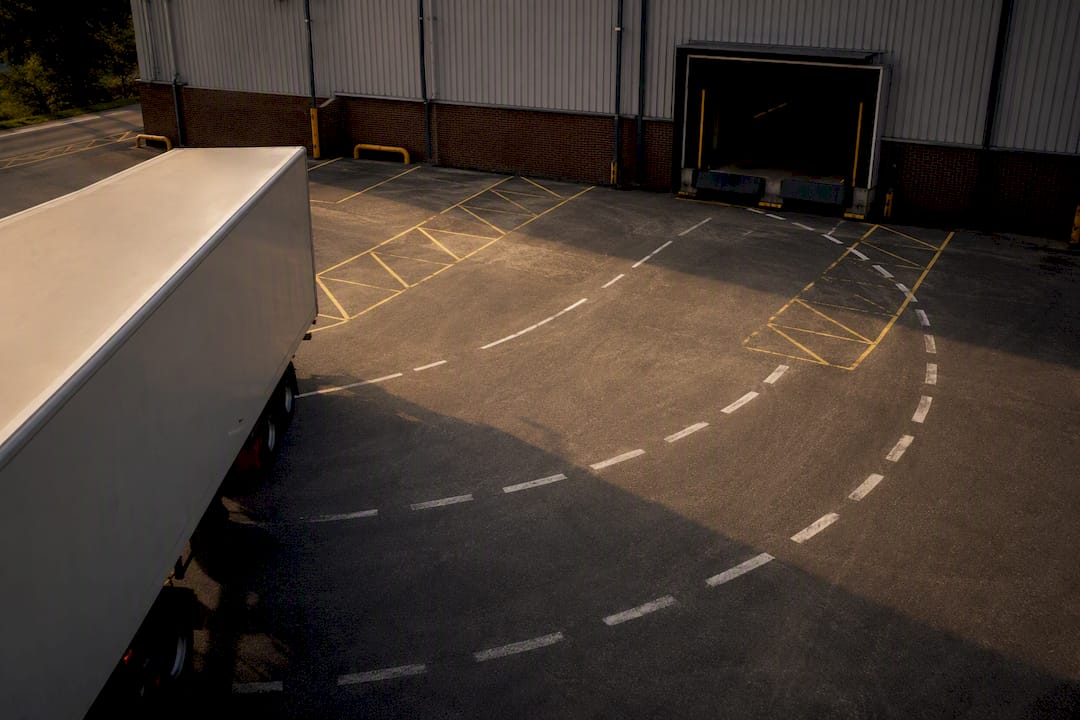
Parking presents a related but distinct problem. Artic combinations at or near 16.5 metres need proportionally longer parking bays than rigid vehicles, and many service areas and lay-bys built before articulated freight volumes grew to current levels now run short of dedicated HGV parking during peak periods. Drivers planning overnight stops on longer runs need to factor this into route timing, particularly on corridors where lorry parking capacity hasn't kept pace with freight growth.
For operators, this means site-specific access information, gathered on first delivery and retained for future bookings, is often more valuable than any generic dimension guide when deciding which trailer type to send.
What penalties apply for dimension violations in the UK?
Enforcement of dimension and weight rules falls to the Department for Transport and its enforcement arms, working alongside police traffic units who carry out roadside checks. Penalties scale with the severity and nature of the breach rather than applying a single flat fine.
Overlength or overwidth combinations running without the correct authorisation for their category can face fixed penalty notices at the roadside, with more serious or repeated breaches referred for prosecution. Weight offences follow a similar pattern, but enforcement here tends to be stricter because axle overloading has a direct and measurable link to road damage and braking performance, both of which affect other road users' safety.
Operator licences carry the heaviest long-term risk. The Traffic Commissioner can call an operator to a public inquiry following persistent dimension or weight breaches, and outcomes range from licence conditions and curtailment through to full revocation for the most serious or repeated cases. That risk sits above any individual fine, because it threatens the ability to run vehicles at all.
Bridge strikes carry a distinct penalty track, often involving both a criminal charge for the driver and substantial civil liability for infrastructure damage, which can run into tens of thousands of pounds depending on the structure affected. Insurers increasingly scrutinise whether proper route-planning checks were documented before a claim following a strike, which is precisely why the pre-departure checklist covered earlier matters as much for financial protection as for legal compliance.
What do operators get wrong about artic dimensions?
The phrase "no legal maximum height" gets misread constantly, and it's the single most common source of preventable bridge strikes across the fleets we support. Operators hear "no limit" and stop checking clearances, when the correct reading is the opposite: because the law sets no ceiling, the entire burden of avoiding a strike sits with the operator's own route planning, every single time.
Trailer geometry mistakes show up more often than raw length breaches. Fleets frequently choose a trailer based on advertised capacity without checking kingpin position against the destination's access constraints, then discover on arrival that the combination cannot physically turn into the yard.
The ministry plate deserves more respect than it usually gets. Two trailers of the same model can carry different plated limits, and weight distribution records matter as much as the plate itself when an axle check goes wrong at the roadside.
— Ayomide
How SDD by ABA handles compliant artic movements
Getting an articulated lorry job right starts long before the vehicle leaves the yard, and that's exactly where SDD by ABA earns its keep. Instead of assigning whatever artic happens to be free, we match trailer type, dimensions and axle configuration to the actual site, route and cargo before confirming a booking, drawing on our wider fleet from 7.5 tonne trucks through to full artic and container transport vehicles.

That matters most on jobs with tight loading bays, awkward rural access or bridge-restricted routes, precisely the scenarios covered throughout this guide. If your delivery point has caught out drivers before, tell us when you book and we'll plan the vehicle and route accordingly rather than leaving it to chance on the day. For construction materials, retail stock or time-critical freight that needs a dimensionally suitable artic, explore our freight haulage services or the dedicated artic truck transport page for specifics on what we run. Get in touch through Sddbyaba for a route-specific quote, and we'll confirm compliance details, including height and access checks, before your job is scheduled.
Sources
- The Road Vehicles (Construction and Use) Regulations (SI 2023/524)
- Gov
- Vehicle dimensions: in‑depth — Croner