
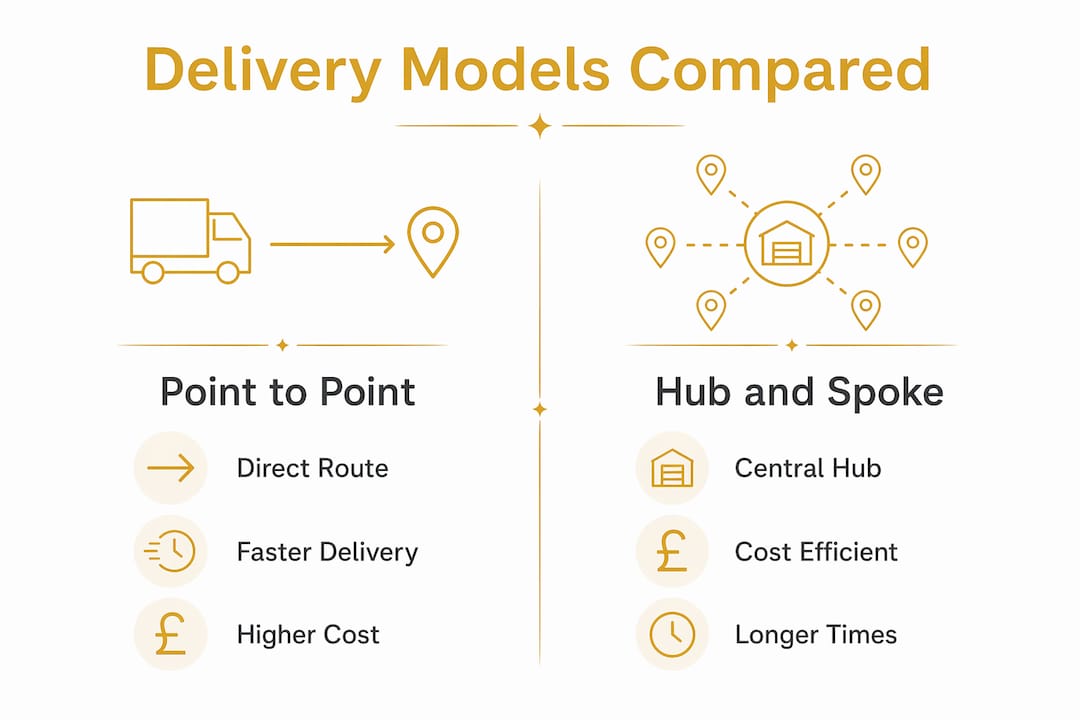
Point to point delivery is the direct transportation of goods from a single collection point to a single destination, with no intermediate stops, sorting hubs, or transfer depots along the way. One vehicle, one driver, one uninterrupted route. In UK courier services, this model is often called a direct service, where the driver collects a consignment and travels straight to the recipient without picking up or dropping off anything else en route.
Key characteristics of point to point logistics:
- A single vehicle handles the entire journey from origin to destination
- No goods pass through a central hub or sorting facility
- The route is uninterrupted, reducing handling and transit time
- Typically used for same day, urgent, or time-sensitive consignments
- Particularly common in metropolitan courier operations and dedicated transport runs
How does point to point delivery compare to hub and spoke?
The hub-and-spoke model routes all shipments through a central depot. Goods from multiple senders converge at the hub, get sorted, consolidated into larger vehicles, and then fan out to their respective destinations. It works well for high-volume, non-urgent freight because consolidation keeps costs down.
Point to point delivery bypasses that process entirely. There is no hub, no sorting, and no waiting for other consignments to fill a vehicle. The trade-off is clear: hub and spoke is more cost-efficient at scale, but a delay at the central hub can cascade across every shipment in that batch. With point to point, a problem affects only the single delivery in question.
| Feature | Point to point | Hub and spoke |
|---|---|---|
| Route type | Direct, origin to destination | Via central hub |
| Speed | Faster for individual shipments | Slower due to consolidation |
| Delay risk | Isolated to one delivery | Can affect entire network |
| Cost efficiency | Higher per-shipment cost | Lower cost at volume |
| Best suited for | Urgent, sensitive, or dedicated loads | High-volume, non-time-critical freight |
What are the main benefits of point to point delivery?
Speed is the most obvious advantage. Because the driver makes a continuous journey with no direction changes or additional stops, transit times are shorter than any multi-stop alternative. For a business waiting on a critical component or a medical facility expecting urgent supplies, that difference is tangible.
- Faster delivery times: No stops means no accumulated delays from other consignments.
- Reduced handling: Goods loaded at origin arrive at destination without being touched again, lowering the risk of damage or loss.
- Operational resilience: A failure in one run does not affect any other delivery, unlike a hub failure that disrupts an entire batch.
- Greater control: The shipper knows exactly which vehicle and driver is carrying their goods throughout the journey.
- Customer confidence: Real-time tracking on a dedicated run is far more predictable than tracking a parcel through multiple transfer points.
For urgent or time-sensitive shipments such as medical supplies, perishable goods, or high-value parcels, point to point is often the only model that genuinely meets the brief.
What are the disadvantages and cost implications?
Point to point delivery costs more per shipment than hub-and-spoke alternatives, and that is not a flaw in the model. It is simply the price of speed and exclusivity. Because each vehicle carries a single consignment rather than a consolidated load, the cost of fuel, driver time, and vehicle wear falls entirely on that one delivery.
- Higher per-shipment cost: No load consolidation means no shared cost across multiple parcels.
- More vehicles and drivers required: Running multiple simultaneous point to point runs demands a larger active fleet than a hub-based operation of equivalent volume.
- Lower overall efficiency: The model is not designed for bulk freight economics. Trying to apply it to high-volume, low-urgency shipments produces poor financial returns.
- Not universally suitable: Standard, non-urgent parcels are almost always better served by consolidated services.
The cost argument shifts when automation enters the picture. Routing software and transport management systems can reduce dead mileage and improve scheduling, bringing point to point costs closer to acceptable levels for businesses that need the speed.
Which types of deliveries suit point to point distribution?
Not every shipment justifies a dedicated vehicle. Point to point delivery earns its premium when the consequences of delay, damage, or mishandling outweigh the cost difference.
- Same day urgent deliveries: Time-critical consignments where a few hours matter, such as legal documents, engineering parts, or retail replenishment stock.
- Medical and pharmaceutical goods: Hospitals, clinics, and laboratories regularly require direct transport for specimens, medications, and equipment.
- Perishable foods and temperature-sensitive cargo: Direct routing minimises the time goods spend in transit, preserving quality.
- High-value or fragile items: Reduced handling means fewer opportunities for damage or theft.
- Metropolitan direct runs: In cities, direct courier services typically complete deliveries within 90 minutes, making them the fastest option available.
- Construction and engineering components: A delayed part can halt an entire site. A dedicated vehicle eliminates that risk.
Pro Tip: If your shipment has a hard deadline, a financial penalty for late delivery, or a fragile or perishable nature, point to point is almost certainly the right choice regardless of the cost premium.
How do automation and technology support point to point delivery?
The decentralised nature of point to point logistics creates a genuine operational challenge: managing many simultaneous independent runs without losing visibility or control. Technology closes that gap. Automated dispatch software handles route optimisation, driver scheduling, and recipient notifications, reducing the manual overhead that would otherwise make point to point unworkable at scale.
- Transport management systems (TMS): Automate route planning, assign the nearest available vehicle, and flag potential delays before they occur.
- Real-time GPS tracking: Gives both the courier operator and the client live visibility of every active run.
- Automated notifications: Customers receive collection and delivery confirmations without manual intervention from the dispatch team.
- Driver productivity tools: Mobile apps allow drivers to confirm collections, capture proof of delivery, and communicate exceptions instantly.
The result is that a well-equipped courier operation can run multiple simultaneous point to point deliveries with the same administrative overhead that once required a much larger back-office team.
How Sddbyaba handles point to point delivery across the UK
Sddbyaba operates as a dedicated same day courier and logistics provider, built specifically around the demands of point to point transportation. The fleet spans motorcycles and cars through to 7.5 tonne, 12 tonne, 18 tonne, and 26 tonne trucks, artic lorries, and container transport vehicles, which means the right vehicle is available for the right consignment regardless of size or urgency.
Industries served include construction, retail and e-commerce, manufacturing, medical and healthcare, engineering, and commercial logistics. Each sector brings its own version of time-critical freight, and Sddbyaba's dedicated courier services are structured to handle them without the delays inherent in consolidated networks.
| Vehicle type | Typical use case |
|---|---|
| Motorcycle / car | Urgent documents, small parcels, metropolitan runs |
| Small to medium van | Same day retail stock, medical supplies |
| Luton / long wheelbase van | Larger commercial consignments |
| 7.5–26 tonne truck | Freight, pallets, construction materials |
| Artic lorry | Full load haulage, container transport |
Professional communication throughout every run underpins the client experience. Sddbyaba's approach means businesses receive updates at each stage rather than waiting for a delivery confirmation that may or may not arrive.
Key challenges in implementing point to point delivery
Running a point to point operation at any meaningful scale presents real logistical pressure. The absence of a central hub means there is no natural consolidation point to absorb inefficiencies.

Vehicle utilisation is the most persistent challenge. A dedicated vehicle travelling to a single destination may return empty, which adds cost without generating revenue. Operators address this through dynamic scheduling and return-load matching, but it requires active management.
Driver availability across a wide geographic area is equally demanding. Unlike hub-based models where drivers work defined local zones, point to point runs can span any distance, requiring a flexible and responsive driver pool.
Cost management without sacrificing service quality demands investment in routing technology and disciplined dispatch processes. Without those tools, point to point quickly becomes financially unsustainable for all but the highest-value consignments.
How point to point delivery affects speed and customer satisfaction
The relationship between point to point logistics and customer satisfaction is direct. Faster, more predictable deliveries produce better outcomes for the businesses receiving them. When a consignment travels on a dedicated vehicle with no intermediate stops, the delivery window is far tighter and more reliable than any consolidated service can offer.
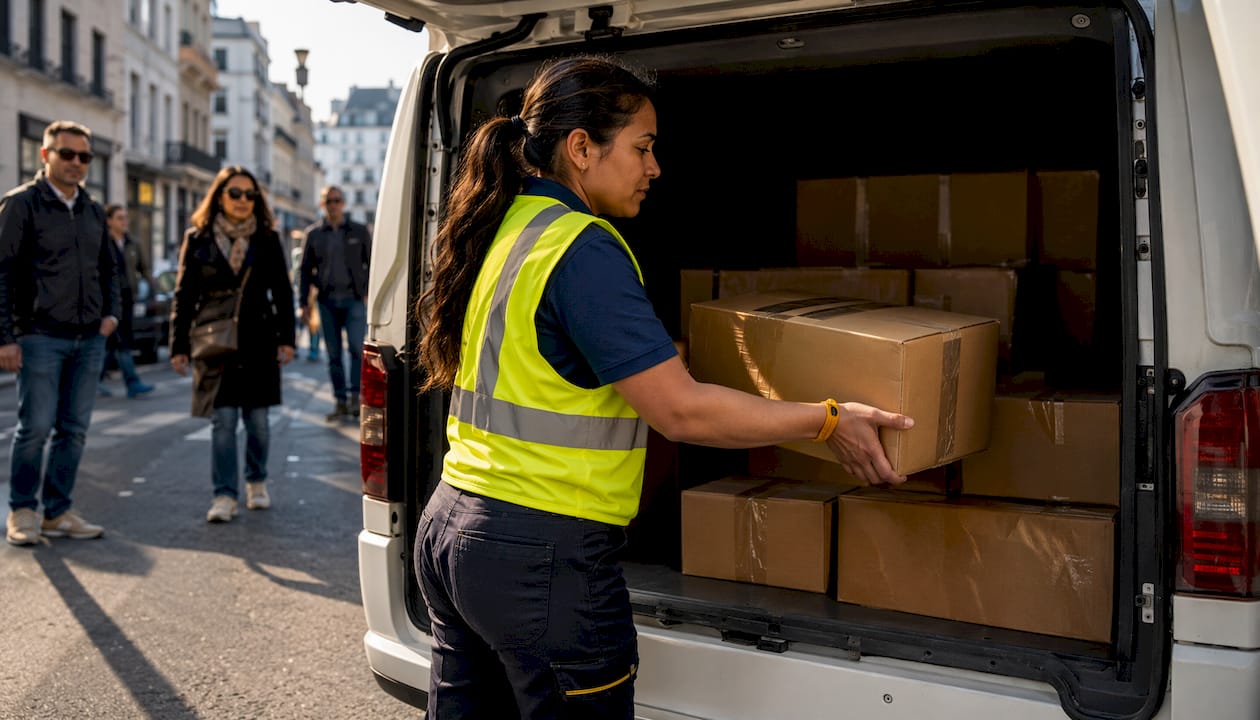
For businesses operating in sectors where downtime is costly, such as manufacturing, construction, or healthcare, that reliability translates directly into operational continuity. A part that arrives on time keeps a production line running. A medical supply that arrives within the hour meets a clinical need. The premium paid for point to point delivery is, in those contexts, a straightforward business decision.
Technological innovations making point to point delivery more efficient
The gap between point to point's speed advantage and its cost disadvantage is narrowing, largely because of advances in logistics technology. AI-driven route optimisation now calculates the fastest path in real time, accounting for live traffic, road closures, and vehicle capacity. This reduces journey times and fuel consumption simultaneously.
Electric vehicle adoption within courier fleets is reducing the per-kilometre operating cost of dedicated runs, making point to point more financially accessible for a wider range of shipments. Telematics systems provide granular data on driver behaviour, fuel use, and vehicle performance, giving operators the insight to reduce waste across their fleet.
Proof of delivery platforms, integrated directly into driver mobile apps, eliminate paper-based processes and provide instant, timestamped confirmation that goods have arrived. For clients in regulated industries such as pharmaceuticals or legal services, that audit trail is as valuable as the delivery itself.
Key takeaways
Point to point delivery is the fastest and most reliable logistics model for urgent, sensitive, or high-value shipments, and its cost premium is justified when speed and control genuinely matter.
| Point | Details |
|---|---|
| Direct routing | Goods travel from origin to destination with no intermediate stops or hubs. |
| Speed advantage | Uninterrupted routes deliver faster than any consolidated or hub-based alternative. |
| Delay resilience | A problem on one run affects only that delivery, not an entire network batch. |
| Cost trade-off | Higher per-shipment cost is offset by speed, reduced handling, and lower damage risk. |
| Technology dependency | Automated dispatch and routing tools are essential for running point to point at scale efficiently. |