
A production line stoppage is defined as the complete or partial halt of a manufacturing or assembly process, caused by a disruption in the flow of materials, components, or information through the supply chain. In logistics, understanding what does production line stoppage mean goes beyond the factory floor. It means recognising that late deliveries, stock inaccuracies, and coordination failures are the upstream triggers that starve a line of what it needs to keep running. The industry term you will encounter most often is "unplanned downtime," and it carries a cost profile that most operations teams significantly underestimate.
What causes production line stoppages in logistics?
Production line stoppages split into two categories: planned downtime and unplanned downtime. Planned downtime covers scheduled maintenance, tooling changeovers, and shift transitions. Unplanned downtime costs 2–3 times more than planned downtime because it triggers emergency responses across procurement, logistics, and production simultaneously.
From a logistics perspective, the causes of unplanned stoppages are specific and traceable:
- Supply delays. A late inbound shipment removes the buffer stock a line depends on. When that buffer reaches zero, the line stops. This is called "line starvation," and it is a logistics failure, not a production failure.
- Inventory inaccuracies. When warehouse records show stock that physically does not exist, production planners schedule against phantom inventory. The line stops when the picker cannot fulfil the pick list.
- Quality holds. A line stop as a quality trigger is a deliberate reactive tool. Production halts immediately upon detection of a quality deviation to prevent defective output from advancing down the line.
- Poor supplier communication. When a supplier fails to flag a delay in advance, the production team has no time to source an alternative. The gap between notification and stoppage collapses to zero.
- Carrier and transport failures. A missed collection, a vehicle breakdown, or an incorrect consignment note can hold critical components at a depot for hours.
A particularly underestimated cause is the micro-stop. Micro-stops under two minutes account for 30–50% of total availability losses in manufacturing environments. They are almost never captured in manual tracking systems, which means operations teams are solving for the visible stoppages while the hidden ones accumulate unnoticed.
Pro Tip: Install automated monitoring on your production line and connect it to your inbound logistics data. When micro-stop frequency rises, it often signals an upstream material flow problem before a full stoppage occurs.

What are the financial and operational effects of production line stoppages?
The visible cost of a production halt is lost output. The less visible costs are what make stoppages genuinely dangerous to a business. Hidden costs frequently exceed visible lost production, accounting for up to 80% of the total financial impact of unplanned downtime.
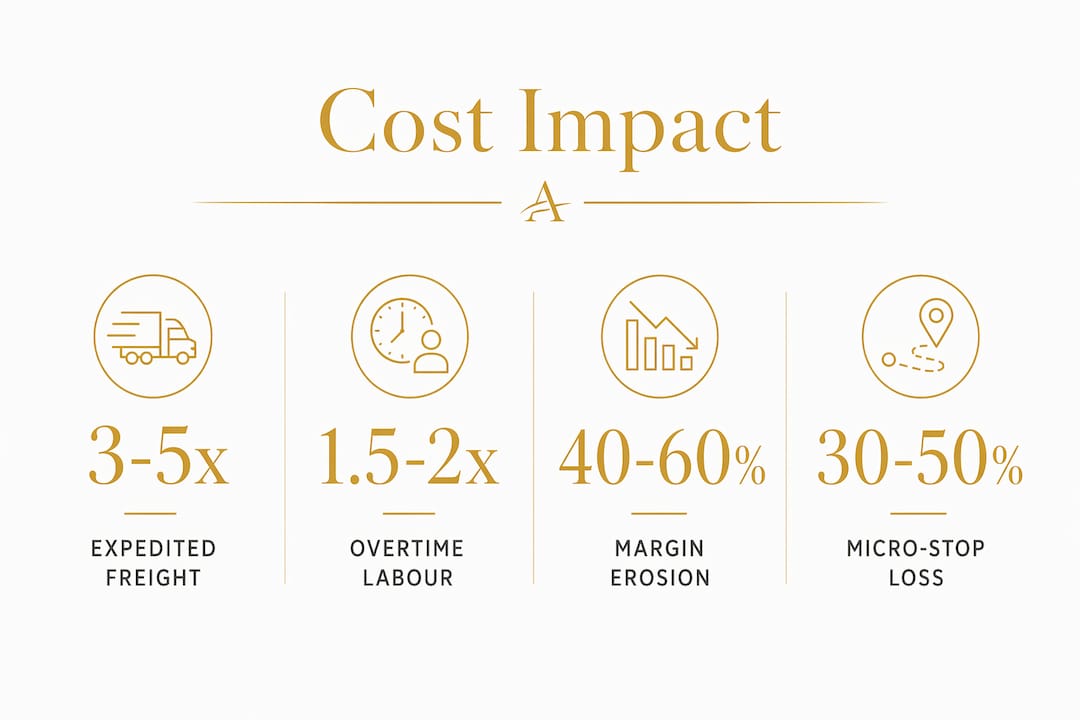
Direct and indirect cost breakdown
| Cost category | Typical multiplier vs. standard rate |
|---|---|
| Expedited freight | 3x–5x normal cost |
| Overtime labour | 1.5x–2x normal rate |
| Quality defect rework | Variable, often significant |
| Contractual penalties | Fixed per contract terms |
| Expedited shipping margin erosion | 40–60% of order margin |
Recovery costs include overtime labour at 1.5x–2x normal rates and expedited freight at 3–5x normal cost. These figures compound quickly when a stoppage extends beyond a single shift.
The cascade effects are equally damaging. Equipment that is emergency-stopped and restarted does not immediately return to normal operating conditions. Restarting equipment post-emergency stop leads to 3–8 times higher defect rates in the first hour of production. That means quality testing costs rise sharply at exactly the moment when the team is already under pressure to recover lost output.
Expedited shipping to preserve customer delivery dates erodes order margins by 40–60%. A single stoppage can turn a profitable order into a loss-making one before the production manager has written the incident report.
Scheduling chaos is another consequence that rarely appears in cost models. When one line stops, the knock-on effect hits downstream assembly, warehouse despatch, and customer delivery windows simultaneously. Inventory that was correctly positioned for one production run becomes misaligned for the recovery run. The logistics team then faces a second wave of reactive decisions under compressed timelines.
How does logistics integration prevent production line stoppages?
Treating downtime as a systemic symptom rather than an isolated event is the single most effective shift a logistics team can make. Integration between procurement, quality assurance, and production scheduling removes the information gaps that allow stoppages to develop undetected.
A practical framework for proactive logistics management looks like this:
- Establish real-time supplier visibility. Connect your supplier network to a shared platform so that delays are flagged before they become shortages. Systems like Manufacturing Execution Systems (MES) and Overall Equipment Effectiveness (OEE) tools provide the production-side data. Pair them with inbound logistics tracking for a complete picture.
- Maintain accurate inventory records. Cycle counting, barcode scanning, and regular stock reconciliation eliminate the phantom inventory problem. A discrepancy caught on a Tuesday prevents a stoppage on a Thursday.
- Build supplier communication protocols. Require suppliers to notify you of any delay exceeding a defined threshold, typically four hours for time-critical components. This gives your team time to source alternatives or arrange expedited transport.
- Pre-qualify emergency logistics providers. When a stoppage is imminent, you need a carrier on the phone within minutes, not hours. Pre-agreed rates, vehicle availability, and collection windows remove the delay from the response.
- Review and act on micro-stop data weekly. Micro-stop patterns reveal which components, suppliers, or processes are generating the most friction. Addressing them proactively reduces the probability of a full stoppage.
Pro Tip: Build a contingency logistics plan that specifies which carrier to call, which vehicle type is needed for your most critical components, and what the maximum acceptable transit time is. Review it quarterly. A plan that exists only in someone's head is not a plan.
Checking the factory holiday and cargo cutoff calendar from ForwarderOne is a practical step for teams sourcing internationally. Supplier shutdowns during national holidays are a predictable cause of logistics production delays that contingency planning can absorb entirely.
How do logistics providers support recovery after a production halt?
When a stoppage has already occurred, the priority shifts from prevention to recovery speed. The logistics provider becomes a critical partner in that recovery. The faster critical components reach the production line, the lower the total cost of the stoppage.
Effective logistics support for post-stoppage recovery includes:
- Same day courier despatch. For components that can be transported by van or smaller vehicle, same day collection and delivery is the fastest available option. It bypasses standard freight networks and their associated lead times.
- Dedicated vehicle transport. A dedicated vehicle carries only your consignment, with no intermediate stops or consolidation delays. For time-critical parts, this is the correct choice.
- Heavy freight and haulage. For larger components, machinery parts, or pallet quantities, a freight haulage service with same day capability removes the wait for the next scheduled run.
- Pallet delivery. When the recovery requires bulk components rather than individual parts, pallet delivery with a fast turnaround keeps the volume moving without sacrificing speed.
- Real-time communication. A logistics provider that gives you live tracking and proactive updates allows your production team to plan the restart sequence accurately. Uncertainty about arrival time creates its own scheduling problems.
Understanding how emergency deliveries prevent downtime is worth studying before a stoppage occurs. The businesses that recover fastest are those that have already mapped their emergency logistics options and know exactly which service to deploy for each type of component.
Key takeaways
Production line stoppages in logistics are primarily caused by upstream supply failures, and their true cost is dominated by hidden expenses that most operations teams fail to track until after the event.
| Point | Details |
|---|---|
| Define the stoppage type | Distinguish planned from unplanned downtime to apply the correct response and cost model. |
| Track micro-stops actively | Micro-stops under two minutes cause 30–50% of availability losses and require automated monitoring to capture. |
| Calculate the full cost | Hidden costs including expedited freight, overtime, and quality defects account for up to 80% of total stoppage impact. |
| Integrate logistics and production planning | Connecting supplier visibility, inventory accuracy, and production scheduling prevents most logistical stoppages. |
| Pre-qualify emergency carriers | Having a logistics provider ready before a stoppage occurs cuts recovery time and limits cost escalation. |
Why downtime is a logistics problem, not just a production problem
The framing of production line stoppages as a manufacturing issue is the most persistent mistake I see in supply chain management. Production managers own the line. Logistics managers own the flow. But when the line stops because a delivery was late or a stock record was wrong, both teams point at each other and the stoppage extends.
The operations that recover fastest treat downtime as a shared systemic failure. They do not ask "why did the line stop?" They ask "where did the material flow break down, and how far upstream did it start?" That question almost always leads back into logistics: a supplier that did not communicate, a carrier that missed a collection, an inventory system that had not been reconciled in three weeks.
Micro-stops are where this becomes most revealing. A line that stops for 90 seconds, restarts, stops again for two minutes, and repeats that pattern across a shift is not a production problem. It is a material flow problem. The components are arriving inconsistently, or the pick process is generating errors, or the inbound quality check is holding parts too long. None of those causes sit on the production floor.
The 2026 operating environment has added pressure to this dynamic. Tighter freight capacity, longer international lead times, and more frequent supplier disruptions mean that the margin for error in logistics planning has shrunk. The teams that are managing this well have invested in visibility tools, pre-qualified emergency carriers, and cross-functional communication protocols. The teams that are struggling are still treating each stoppage as a one-off incident rather than a signal from the system.
— Ayomide
How Sddbyaba supports production continuity when it matters most

When a production line stops and every minute of delay carries a cost, the logistics response needs to be immediate and dependable. Sddbyaba provides same day courier and freight services across the UK, with dedicated vehicles ranging from motorcycles and vans through to 26-tonne trucks and artic lorries. Whether you need a single urgent component delivered within hours or a full pallet of production parts moved the same day, Sddbyaba's nationwide fleet is ready to respond. For manufacturing, engineering, and commercial logistics clients, the dedicated courier service offers direct, uninterrupted transport with live communication throughout. Contact Sddbyaba to discuss your emergency logistics requirements and get a response plan in place before the next stoppage occurs.
FAQ
What does production line stoppage mean in logistics?
A production line stoppage in logistics refers to the halt of a manufacturing process caused by a disruption in material supply, delivery, or inventory management. The industry term is unplanned downtime, and it is most commonly triggered by late deliveries, stock inaccuracies, or supplier communication failures.
What is the difference between planned and unplanned downtime?
Planned downtime covers scheduled events such as maintenance and changeovers, and its costs are budgeted in advance. Unplanned downtime costs 2–3 times more because it requires emergency responses including expedited freight and overtime labour.
What are the hidden costs of a production line stoppage?
Hidden costs include expedited freight at 3–5x normal rates, overtime labour at 1.5–2x normal rates, quality defect rework, and contractual penalties. These hidden costs account for up to 80% of the total financial impact of unplanned downtime.
What is a line stop in quality management?
A line stop is a quality assurance tool that halts production immediately when a defect or deviation is detected. It acts as a containment measure to prevent defective products from advancing further down the production line.
How can logistics providers help reduce production line downtime?
Logistics providers reduce downtime by offering same day despatch, dedicated vehicle transport, and real-time tracking for urgent component deliveries. Fast freight options cut the time between a stoppage and a restart, directly reducing the total cost of the incident. Reviewing common emergency delivery mistakes helps teams avoid errors that extend recovery time.