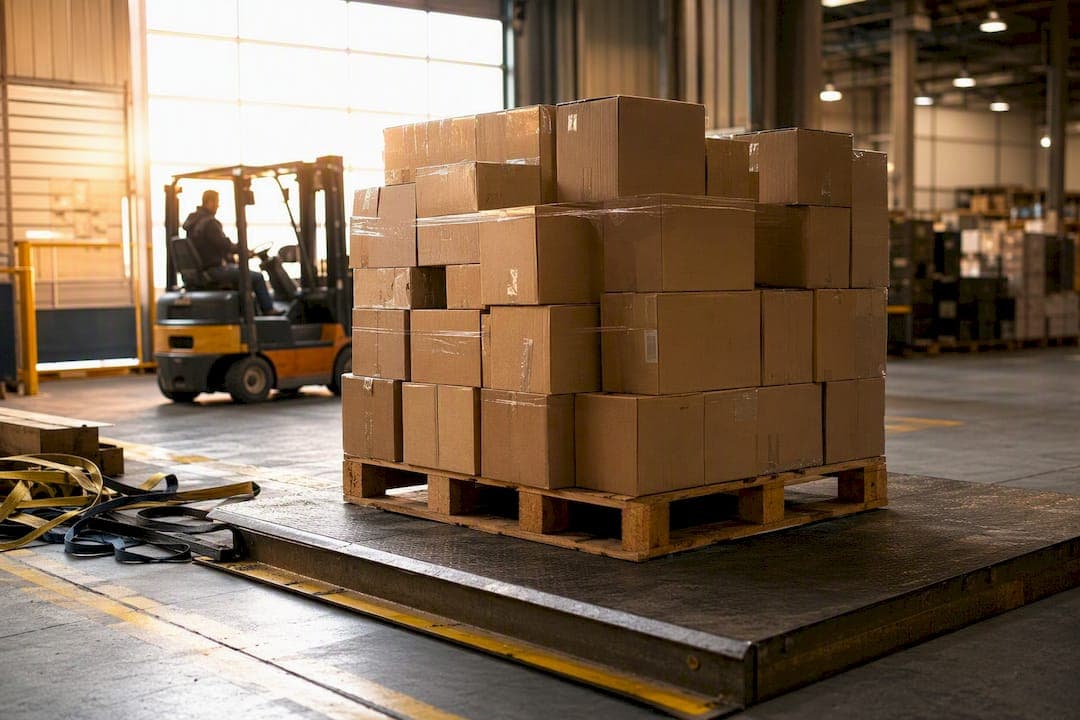
The UK standard pallet footprint is 1,200 × 1,000 mm, known in the trade as the GB pallet. The Euro pallet measures 1,200 × 800 mm. Carriers typically classify pallets by height: full pallets run to roughly 2,200 mm, half pallets around 1,200 mm, and quarter pallets about 800 mm, though bands vary between networks.
- UK standard (GB pallet): 1,200 × 1,000 mm
- Euro pallet: 1,200 × 800 mm
- Full pallet height: ≈2,200 mm | load capacity ≈1,000–1,200 kg
- Half pallet height: ≈1,200 mm | load capacity ≈400–500 kg
- Quarter pallet height: ≈800 mm | load capacity ≈250 kg
Those figures are your starting point for booking, racking and vehicle planning. Everything below explains the nuance that decides whether they hold in practice.
TL;DR:
- Confirm your pallet's footprint size and height band before booking to avoid inefficiencies and extra costs during transport.
- Standardize on a single pallet size, such as Euro or UK standard, to improve load planning and reduce handling complexities.
- Check carrier-specific height thresholds and weight capacities to ensure your pallets stay within booked categories and load limits.
- Re-palletize goods at the inbound dock whenever possible to minimize handling costs and optimize space utilization.
- Use appropriately sized vehicles for urgent or large shipments, and communicate non-standard dimensions in advance to prevent delays.
Table of Contents
- Standard footprints and common pallet sizes in UK operations
- How full, half and quarter pallet bands actually work
- UK pallet versus Euro pallet: what changes for cross-border loads
- How many pallets fit on a lorry or in a container?
- Getting handling and racking right for mixed pallet estates
- When oversize or custom pallets cost you more
- A checklist for choosing the right pallet and booking type
- Material types used for UK pallets and how they affect size and load
- Weight distribution and load securing for safer, more efficient pallets
- Regulatory and safety standards for pallet sizes and stacking
- Key Takeaways
- Sources
Standard footprints and common pallet sizes in UK operations
Most UK freight moves on one of five footprints, and knowing which one applies to your goods saves a lot of wasted trailer space. The UK standard pallet measures 1,200 × 1,000 mm (roughly 47.2 × 39.4 inches) and dominates domestic distribution. The Euro pallet, at 1,200 × 800 mm (47.2 × 31.5 inches), turns up wherever goods arrive from or travel to continental Europe.
Beyond those two, you'll meet:
- 1,200 × 1,200 mm industrial pallets, used for heavy or bulky loads that need extra surface area
- 800 × 600 mm and 600 × 400 mm pallets, common in retail display and smaller parcel consolidation
- Pallets built to ISO 6780 footprint tolerances, which is the standard most UK and European manufacturers design against
A four-way timber pallet typically weighs 20 to 30 kg empty, which matters when you're calculating gross vehicle weight on a full trailer load. Retailers favour the smaller footprints because they fit shop-floor cages and till-point displays; construction and manufacturing tend to stick with the 1200×1000 or 1200×1200 formats because the extra deck space carries irregular loads more securely.
How full, half and quarter pallet bands actually work
Carriers rarely book by exact millimetre footprint. They book by height band, and that distinction catches out a lot of first-time shippers. A full pallet sits at roughly 2,200 mm, a half pallet at around 1,200 mm, and a quarter pallet at about 800 mm, though every network sets its own cut-offs. Booking a load as "half pallet" with one carrier and 1,190 mm of product might get accepted; another carrier's threshold could push you into the full-pallet tariff.
- Full pallet: ≈2,200 mm high, typical load 1,000–1,200 kg
- Half pallet: ≈1,200 mm high, typical load 400–500 kg
- Quarter pallet: ≈800 mm high, typical load 250 kg
- Light pallet variants exist below these bands for low-density goods that hit height limits before weight limits
These are nominal figures, not guarantees. A poorly distributed load or one stacked off-centre reduces the safe capacity well below the headline number, and centre-loaded pallets without support at the deck edges are more prone to racking failure. Always check your specific carrier's height cut-offs before booking rather than assuming the industry-standard bands apply.
UK pallet versus Euro pallet: what changes for cross-border loads
The 200 mm width difference between a UK pallet and a Euro pallet looks trivial on paper. In a trailer built around one footprint, that gap creates real inefficiency that compounds across every load you run. A curtainsider optimised for 1200×1000 pallets wastes floor space when loaded with Euro pallets, and vice versa, because neither footprint tessellates cleanly against the other's row width.
Genuine EPAL pallets carry an oval stamp on the corner blocks. That stamp signals membership of the pooled exchange system, meaning a driver can drop an EPAL pallet and pick up an equivalent one rather than returning the same physical unit. An unstamped 1200×800 pallet has the Euro footprint but none of that exchangeability, which matters if your supply chain relies on pallet swaps at the dock.
- If most of your inbound freight arrives on Euro pallets but you distribute domestically, re-palletise at goods-in
- If the reverse is true, standardise on Euro pallets before goods leave your dock
- Fleets that standardise on a single footprint get meaningfully better load planning than those juggling mixed formats
Pro Tip: Standardise wherever labour and space are cheapest, not wherever it's most convenient. Re-palletising at goods-in usually costs less than doing it at the point of dispatch, when time pressure is highest.
How many pallets fit on a lorry or in a container?
Vehicle planning comes down to a handful of figures every transport planner should know by heart.
- A 13.6 metre curtainsider typically takes around 26 UK standard pallets or 33 Euro pallets single-stacked, depending on loading pattern.
- A 40ft container usually holds around 20–21 UK standard pallets or 23–25 Euro pallets, again depending on orientation.
- Double-stacking roughly doubles pallet count on suitable vehicles, but only where product strength, height limits and axle weight allow it.
- Axle weight limits, not just floor space, often cap how many heavy pallets you can legally load, particularly on rigid trucks rather than articulated trailers.
Orientation matters more than most planners expect. Turning pallets 90 degrees against the trailer's length can gain or lose several positions depending on the footprint. And irregular or overhanging loads, so-called "ugly freight," eat into usable floor space disproportionately, sometimes costing you two or three pallet positions for a single oversized item.
Getting handling and racking right for mixed pallet estates
Standard hand pallet trucks use forks around 1,150 mm long, deliberately just short of the 1,200 mm pallet length. That works for both UK and Euro footprints provided you enter from the correct side, but truck width (commonly around 540 mm) still dictates how much aisle clearance you need for safe turning.
- Check fork length against pallet depth before assuming compatibility across your whole fleet
- Rack bay dead height calculations must include pallet height itself, not just the load, because that nominal 144 mm adds up fast across multiple levels
- Mixed footprints (UK and Euro pallets on the same racking) often need adjustable forks or straddle stackers to avoid overhang or unstable stacking
- Warehouses running a genuinely mixed estate should budget for handling equipment flexibility rather than retrofitting racks later
Getting this wrong doesn't just slow down picking. It creates genuine safety risk when a pallet overhangs a rack beam or a forklift can't fully engage a load before lifting.
When oversize or custom pallets cost you more
Anything outside standard footprints, commonly called "ugly freight," triggers different handling from most carriers. Overhanging edges, non-standard heights or irregular shapes consume more floor space than their footprint suggests, and they're harder to stack safely alongside standard loads.
- Expect a surcharge or special handling fee for genuinely oversize pallets
- Pre-notify your carrier with exact measurements before collection, not on the day
- Consider re-palletising onto a standard footprint at goods-in if the product allows it
- Irregular loads that can't be re-palletised should always travel with clear dimensions stated on the booking
A checklist for choosing the right pallet and booking type
Getting this right on a live shipment usually comes down to five steps done in order.
- Audit your inbound and outbound footprint mix to decide where re-palletising will cost you least, typically at goods-in rather than dispatch.
- Measure footprint, height and weight precisely rather than estimating, especially near a carrier's height-band cut-off.
- Check your carrier's exact height bands for full, half and quarter classifications, since these vary between networks.
- Confirm EPAL or pooled status if you're using Euro pallets, checking for the stamped corner blocks.
- Communicate non-standard dimensions to your carrier before collection, not at the point of loading.
Pro Tip: Keep a one-page reference of your carrier's height and weight bands pinned in the goods-out office. It stops last-minute reclassification arguments at the loading bay.
Material types used for UK pallets and how they affect size and load
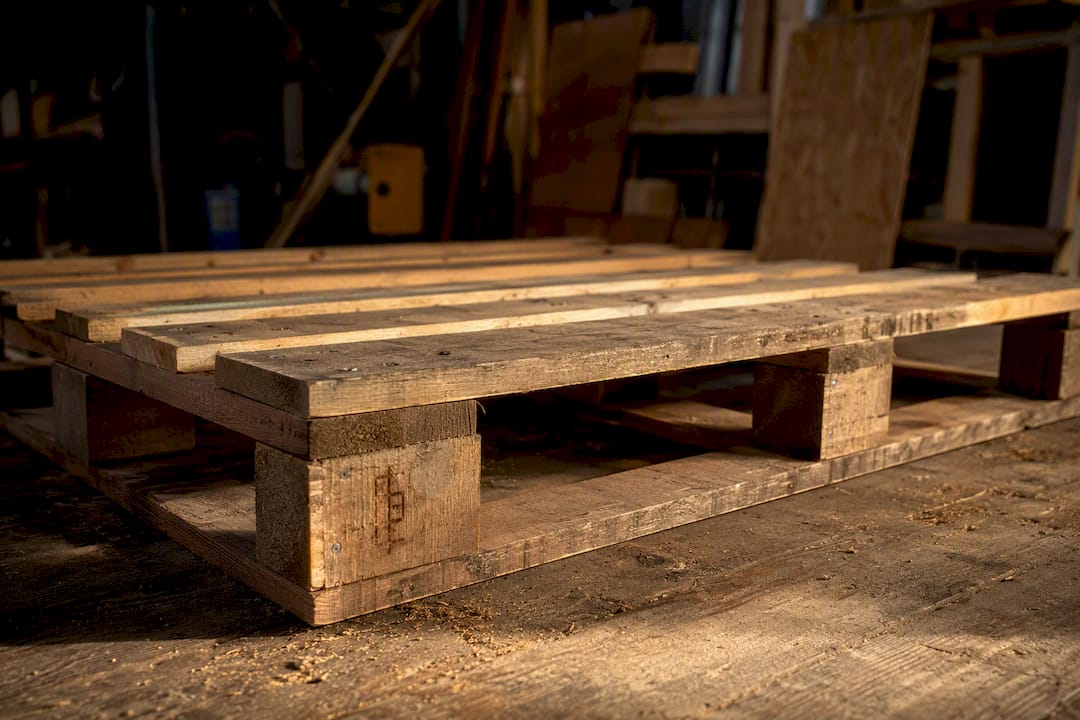
Timber remains the dominant material for UK pallets, and for good reason: it's cheap, repairable, and widely accepted across networks. Standard four-way timber pallets weigh 20 to 30 kg empty and handle the 1,000 to 1,200 kg loads typical of a full pallet booking without issue. Timber pallets used for international export must carry ISPM 15 marking, confirming the wood has been heat-treated or fumigated to prevent pest transfer between countries.
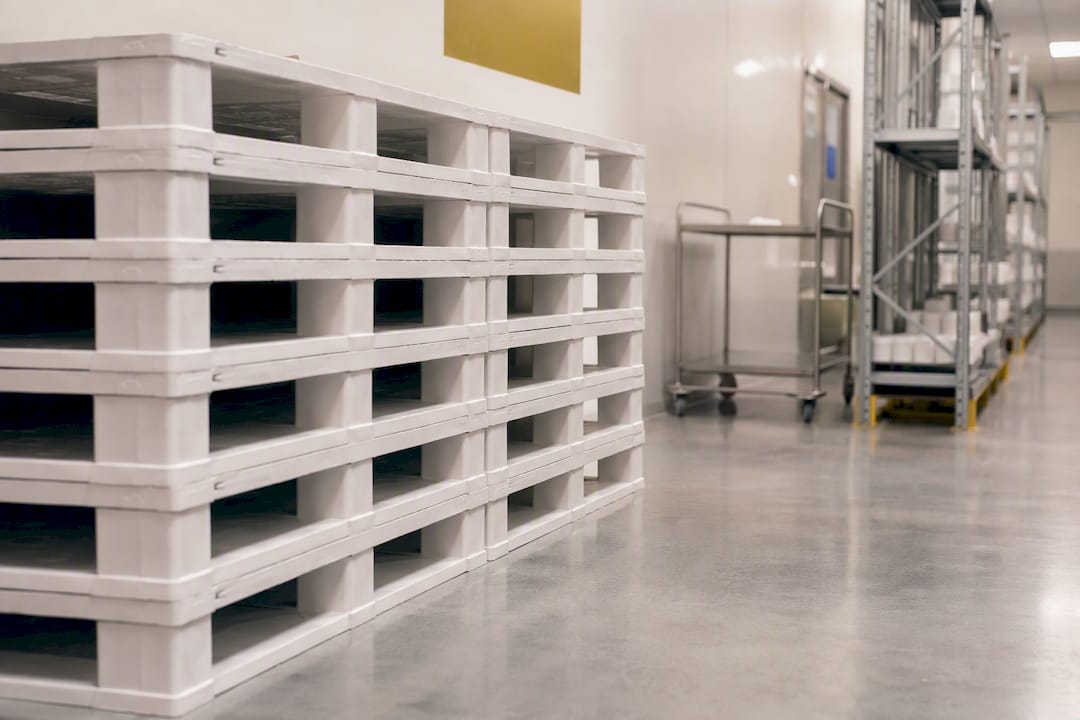
Plastic pallets have grown in food, pharmaceutical and healthcare logistics because they're washable, don't splinter, and hold consistent dimensions over their lifespan, unlike timber, which can warp or shrink with humidity changes. They tend to weigh less than timber equivalents but carry a higher upfront cost, which is why they're more common in closed-loop pooled systems than one-way shipments.
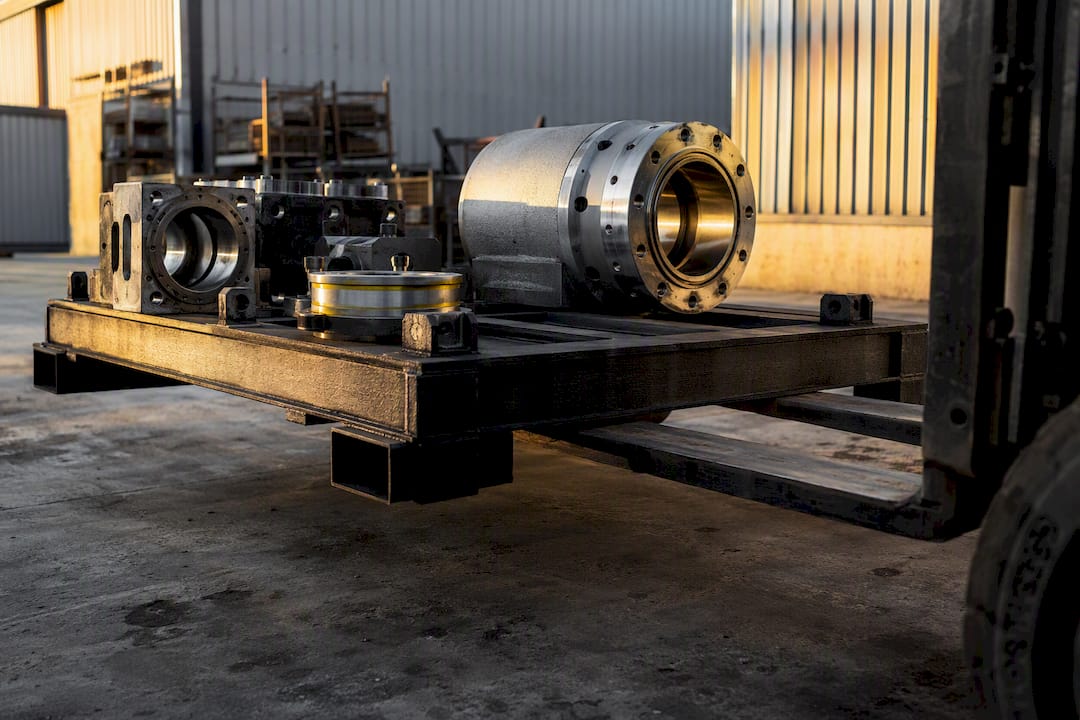
Metal pallets, usually steel, appear where load weights or environmental conditions exceed what timber or plastic can safely handle, such as heavy engineering components or outdoor storage exposed to weather. They're the heaviest option by a wide margin and the least common in general freight, reserved for specialist applications where durability outweighs cost and handling convenience.
Material choice rarely changes the footprint itself, since all three broadly conform to the same ISO 6780 dimensional standards. What changes is the load rating and the empty pallet weight you need to factor into gross vehicle weight calculations, particularly on routes running close to axle limits.
Weight distribution and load securing for safer, more efficient pallets
Poor weight distribution is one of the most common reasons a technically "within limit" pallet still fails in transit or on a rack. Heavier items belong at the base and centre of the pallet, spreading weight evenly across the full deck rather than concentrating it over one corner or edge. Overhang beyond the pallet's footprint, even by a few centimetres, increases instability risk and can breach carrier handling policies outright.
Securing methods matter as much as the stack itself:
- Stretch wrapping remains the standard for most palletised loads, applied in overlapping layers to bind the stack to the pallet deck
- Strapping adds rigidity for heavier or taller loads, particularly where stretch wrap alone won't prevent shifting
- Corner boards and edge protectors stop straps cutting into product edges and help maintain stack squareness
- Anti-slip sheeting between layers reduces the risk of items sliding during transit, especially on mixed-SKU pallets
Centre support matters more than shippers often realise. A pallet loaded heavily at the edges with a hollow middle is far more prone to racking collapse than one with even distribution, even at the same total weight. For multi-drop routes, load the vehicle in reverse delivery order so the first drop sits nearest the door, reducing handling time and the risk of disturbing other pallets mid-route.
Regulatory and safety standards for pallet sizes and stacking
UK pallet practice sits within a framework of international and industry standards rather than a single piece of domestic legislation. ISO 6780 defines the recognised footprint dimensions and tolerances that most UK pallet manufacturers build against, which is why 1200×1000 and 1200×800 pallets behave predictably across different suppliers.
EPAL governs construction and quality standards for pooled Euro pallets, including the stamping system that confirms a pallet belongs to the exchange network rather than being a look-alike footprint outside it. For any pallet, timber or otherwise, moving internationally, ISPM 15 sets the treatment and marking requirements for wood packaging material, a rule enforced at ports and borders rather than something shippers can treat as optional.
Workplace safety obligations around stacking height and racking load limits fall under general UK health and safety duty of care, meaning employers must assess racking dead height, maximum stack height and load stability as part of routine warehouse risk assessment. There's no single "maximum stacking height" number in law; it depends on rack design, pallet condition and load type, which is why rack manufacturers issue load capacity certificates that operations teams should keep on file and review periodically, particularly after any racking damage or reconfiguration.
SDD by ABA perspective: why footprint consistency speeds up same-day dispatch
Standard footprints cut handling time on every same-day job we run. Matching pallet size to the right vehicle, from 7.5 tonne trucks to artics, prevents delays before they start. Get it wrong and even urgent pallet collection slows down.
— Ayomide
Book same-day pallet collection anywhere in the UK
Once you know your pallet's footprint, height band and weight, getting it moving is the next problem. Sddbyaba runs same day pallet collection and delivery nationwide, with a fleet built to match the job rather than forcing your load into whatever vehicle happens to be free that morning.
Our fleet covers everything from 7.5 tonne trucks up to 26 tonne and artic vehicles, alongside vans for smaller or part-pallet consignments. That range means a full pallet load, a half pallet on a mixed drop, or an oversized "ugly freight" item all get matched to appropriately sized transport rather than a one-size-fits-all booking. For heavier or multi-pallet jobs, our 26 tonne freight service handles the load without you needing to split a shipment across two bookings.
If you're planning a pallet move today, request a quote through Sddbyaba's booking page and get a dedicated vehicle confirmed before your goods-out deadline.
Key Takeaways
Standard UK pallet planning rests on three fixed figures: 1,200 × 1,000 mm for domestic loads, 1,200 × 800 mm for Euro pallets, and carrier height bands that determine your booking cost.
| Point | Details |
|---|---|
| Know your footprint | UK standard is 1,200 × 1,000 mm; Euro pallet is 1,200 × 800 mm; check which applies before booking. |
| Match height to carrier bands | Full (~2,200 mm), half (~1,200 mm) and quarter (~800 mm) bands vary between carriers, so confirm cut-offs first. |
| Plan load capacity by band | Budget roughly 1,000–1,200 kg for full pallets, 400–500 kg for half, and 250 kg for quarter pallets. |
| Standardise footprint where cheapest | Re-palletise at goods-in if inbound and outbound formats differ, typically the lower-cost option. |
| Book urgent moves with a matched fleet | Sddbyaba provides same-day pallet collection nationwide using vehicles sized to your footprint and weight. |
Standards and resources to verify dimensions, pooling and timber treatment
- ISO 6780 and UK pallet dimension guidance
- EPAL pooling and Euro pallet standards
- ISPM 15 timber treatment standard
- Further pallet sizing reference for UK operators
Sources
- UK pallet sizes – what are they, and do they affect your packaging?
- UK Pallet Sizes Explained | Standard & Euro Dimensions
- Pallet standards and pooling systems in UK logistics
- ISPM 15 (timber treatment standard)