Same-day delivery is viable for most ecommerce businesses that operate in or near urban centres, hold inventory close to their customers, and are willing to gate the offer by SKU and order value rather than promise it universally. If you sit outside a metro area or ship mostly bulky, low-margin items, same-day remains largely an urban proposition and a national rollout will lose money before it gains customers.
Our recommendation: pilot one or two metro clusters where your order density is highest, or bring in a dedicated courier partner like Sddbyaba to run the delivery leg while you focus on fulfilment.
Three constraints decide whether this works for you:
- Cut-off timing — your last order-acceptance time must leave enough buffer for pick, pack and carrier pickup.
- Inventory proximity — stock has to sit within a short drive of the customer, not in a single national warehouse.
- SKU eligibility — only a portion of your catalogue will ever make sense for same-day economics.
Key Takeaways
Same-day ecommerce delivery succeeds when merchants gate eligibility by SKU and order value, calculate honest cutoffs, and back a primary carrier with automated failover.
| Point | Details |
|---|---|
| Pilot small first | Test 2 to 3 metro clusters with your top-performing SKUs before any wider rollout. |
| Build in cutoff buffer | Display a cutoff 30 to 45 minutes earlier than your calculated carrier pickup limit. |
| Layer your carriers | Combine a regional specialist, on-demand overflow, and national fallback with automated waterfall routing. |
| Gate pricing by value | Use zone-based pricing or minimum order thresholds rather than a flat fee to protect margin. |
| Consider a dedicated partner | Sddbyaba's mixed fleet, from motorcycles to artic lorries, offers a direct route into a same-day pilot without building fleet infrastructure yourself. |
Table of Contents
- What is ecommerce same day delivery and which service type fits your model?
- How do you launch a same-day delivery pilot step by step?
- How do you build carrier failover so same-day promises hold under pressure?
- What pricing and eligibility rules protect same-day margins?
- What technology do you need to run same day shipping ecommerce reliably?
- What should you measure to know if same-day is working?
- Why SDD by ABA is a practical partner for ecommerce same-day needs
- What packaging and handling do same-day orders actually need?
- How should you communicate with customers during same-day delivery?
- How do you handle returns within a same-day delivery model?
- What last-mile challenges are specific to same-day ecommerce?
- How do you staff a same-day fulfilment operation?
- What actually decides whether a same-day pilot succeeds
- Get a same-day quote or pilot from SDD by ABA
- Sources
What is ecommerce same day delivery and which service type fits your model?
Same-day delivery means the order reaches the customer's door the same day it's placed. Same-day dispatch is a narrower promise: the parcel leaves your warehouse and reaches a carrier that day, but arrival might slip to the following morning. Shopify's definition draws that distinction clearly, and it matters because conflating the two on your product page sets expectations you can't always meet.
Beyond that split, ecommerce rapid delivery breaks into a few operational formats:
- Timed windows — customer picks a delivery slot (e.g. 6pm to 9pm); works well for DTC brands with predictable local demand.
- Dedicated runs — a single vehicle, single drop; suits B2B merchants sending time-critical or high-value consignments.
- Grocery-style rapid — 20 to 60 minute store-to-door delivery, as Tesco's Whoosh demonstrates, but this only works with dense micro-fulfilment nodes.
- Store-as-warehouse / micro-fulfilment — retail stock doubles as local inventory, ideal for marketplace sellers with multiple physical locations.
Marketplace sellers without local stock generally can't compete on grocery-style speed. Timed windows or dedicated runs are the realistic starting point.
How do you launch a same-day delivery pilot step by step?
A pilot only proves anything if it's scoped tightly enough to fail safely. Here's the sequence that keeps risk low while still generating real data.
- Pick 2 to 3 metro clusters using your existing order-density data — go where you already have volume, not where you wish you had it.
- Stage only your top-performing SKUs. Around 20% of catalogue items typically drive 80% of same-day demand, so build SKU-level eligibility flags into your order management system (OMS) rather than opening the offer catalogue-wide.
- Calculate your real cutoff. Work backwards from carrier pickup time, then subtract pick and pack time, then subtract a safety buffer. Displaying a cutoff 30 to 45 minutes earlier than your true calculated limit protects reliability when things go wrong.
- Choose your fulfilment model. Ship-from-store, a micro-fulfilment node, or a 3PL partner each carry different cost and control trade-offs. Staff the pilot with a dedicated priority pick/pack lane so same-day orders never queue behind standard ones.
Pro Tip: Run your pilot for four full weeks before judging it. Same-day demand is lumpy week to week, and one strong Tuesday tells you nothing about whether the model holds up under a Black Friday spike.
How do you build carrier failover so same-day promises hold under pressure?
A single-carrier strategy breaks the first time that carrier has a bad day, and in same-day delivery a bad day means missed promises, not just delays. A layered carrier model spreads that risk across three tiers:
- Regional specialist — your primary courier for the pilot metro, chosen for local knowledge and speed.
- On-demand overflow — a gig-style platform that absorbs surge volume when your primary tier is at capacity.
- National fallback — a broader network that catches anything the first two tiers can't cover, even if it means a next-day promise instead of same-day.
Your OMS should run waterfall routing automatically: if pickup confirmation doesn't arrive within a set window, the order reassigns to the next tier and the customer gets an updated estimated time of arrival (ETA) without a human intervening. When negotiating contracts, ask for pickup confirmation service-level agreements (SLAs) and credits tied to missed windows, not just delivery SLAs. Reserve dedicated vehicles for consignments where a single missed pickup would be commercially damaging (medical goods, high-value freight); brokered drivers make more sense for standard parcel volume where cost per drop matters more than continuity of driver.
What pricing and eligibility rules protect same-day margins?
Same-day costs more to run than standard shipping, and pretending otherwise erodes margin fast. Start by calculating your true all-in cost per same-day order: carrier fee, pick/pack labour, packaging, and a share of your node or warehouse overhead.
From there, three pricing levers work in combination:
- Flat fee — simplest for customers, riskiest for you if distances vary widely.
- Zone or distance-based pricing — matches cost to delivery distance, better margin protection.
- Minimum order value (AOV) gate — same-day only unlocks above a threshold, which protects margin without killing conversion in dense metro markets.
Exclude oversized or heavy SKUs from eligibility outright. A same-day promise on a 20kg item usually costs more to fulfil than the item's margin can absorb. Test pricing changes as A/B attach-rate experiments rather than blanket rollouts, so you can see exactly where the price ceiling sits before you commit to it storewide.
What technology do you need to run same day shipping ecommerce reliably?
The checkout page is where same-day promises get made or broken, so your technology stack needs to enforce reality, not just display it. Three layers matter:
- OMS/WMS and carrier router — platforms like ShipStation, EasyPost or Shippo calculate live rates and enforce cutoff logic automatically rather than relying on a spreadsheet someone forgets to update.
- Last-mile visibility tools — Onfleet or Track-POD give you real-time tracking and proof of delivery, which matters both for customer trust and for resolving disputes quickly.
- Checkout UX elements — a live cutoff countdown, delivery-date widgets, and product detail page (PDP) badges showing same-day eligibility stop customers ordering into a promise you can't keep. Hosted platforms increasingly support this natively, reducing the custom build required.
Webhooks connecting your OMS to carrier confirmation APIs are what make waterfall routing actually automatic. Without them, someone on your team is manually checking pickup status, and that person becomes your single point of failure. For a broader view of how orchestration platforms handle multi-carrier routing, SimplyParcel's courier platform roundup is a useful reference point.
What should you measure to know if same-day is working?
Two sets of numbers tell you whether to scale or pause. Operationally, track on-time delivery rate (target 95% or higher), exception rate, and average pickup confirmation time. Financially, track cost per order, cost as a percentage of average order value (AOV), and any conversion lift or attach rate the offer generates at checkout.
- Segment every metric by node, SKU, and carrier — averages hide the metro cluster that's quietly losing money.
- Pause coverage where on-time rate drifts below your target for two consecutive weeks; expand only where cost per order is falling as volume grows.
Why SDD by ABA is a practical partner for ecommerce same-day needs
Standing up same-day infrastructure from scratch takes months. Working with an established courier partner compresses that timeline to weeks. Sddbyaba runs a fleet spanning motorcycles, small and long-wheelbase vans, Luton vans, and 7.5 to 26 tonne trucks up to artic lorries, which means the same partner can handle a single urgent parcel and a pallet of retail stock on the same day.
That range matters for ecommerce specifically, because same-day demand rarely arrives in one shape:
- Urgent parcel dispatch for DTC orders that need a motorcycle or small van, not a full truck.
- Pallet distribution for retailers restocking a store-as-warehouse node.
- Dedicated vehicle transport for B2B or medical-sector shipments where a single missed pickup isn't an option.
Sddbyaba already supports retail and ecommerce alongside construction, manufacturing, and healthcare clients, giving the operation practical experience juggling mixed vehicle types under time pressure. A hybrid carrier strategy needs at least one tier that shows up reliably regardless of surge; a dedicated courier partner is built to be exactly that.
What packaging and handling do same-day orders actually need?
Same-day packaging has different priorities to standard shipping, because the parcel moves faster and often changes hands more times in a shorter window. A box designed to survive a week in a sortation network is over-engineered for a same-day run, but a box designed for speed without protection fails just as easily.
Start with weight and stackability. Same-day drivers, whether on a motorcycle or in a van doing a multi-drop route, need parcels that are quick to identify and load without unpacking a tightly stacked vehicle. Clear, high-contrast labelling with the delivery window printed on the outside reduces handling time at every touchpoint, which matters when a driver has fifteen drops before a cutoff.
Fragile or temperature-sensitive SKUs need particular attention, since same-day promises often mean less buffer time for damage to be caught before it reaches the customer. Build a simple triage rule into your pick/pack process: anything requiring specialist packaging (insulated liners, rigid outers, extra void fill) either gets excluded from same-day eligibility or routed to a picking lane with the right materials on hand.
Right-sized packaging also affects your unit economics directly. Oversized boxes cost more to store at a micro-fulfilment node, take up more space in a delivery vehicle, and slow down multi-drop routing. If you're gating SKUs for same-day eligibility already, use that same review to flag which items need packaging redesigned specifically for speed rather than just borrowing your standard shipping carton.
How should you communicate with customers during same-day delivery?
Same-day customers expect a different communication rhythm to standard shipping customers, mostly because the entire order-to-doorstep window is compressed into hours rather than days. Silence reads very differently when someone is expecting a parcel by 6pm rather than by Thursday.
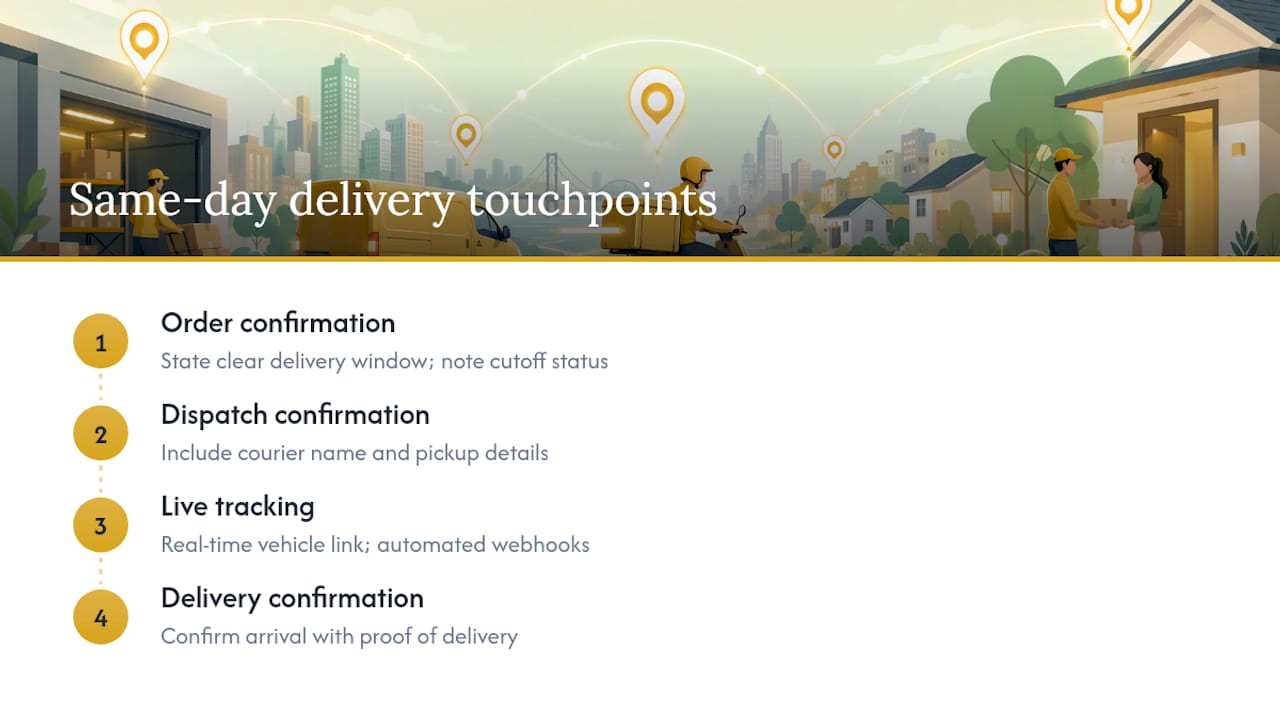
Set expectations at the point of purchase first. A confirmation message should state the delivery window clearly, not just "today", and should flag immediately if the order has passed the cutoff and shifted to next-day. From there, a same-day order typically needs three to four touchpoints: order confirmation, dispatch confirmation with courier details, a live tracking link once the vehicle is en route, and a delivery confirmation with proof of delivery.
Proactive notification matters more than reactive support here. If a carrier misses a pickup window and your waterfall routing reassigns the order, tell the customer immediately with a revised ETA rather than waiting for them to ask. That single habit prevents the majority of same-day complaints, because most frustration comes from uncertainty, not from the delay itself.
Live tracking links, ideally showing the courier's real-time position rather than a static status update, reduce inbound customer service queries substantially during a same-day launch. Build your notification triggers directly into the webhooks connecting your OMS and carrier confirmation APIs, so updates fire automatically rather than depending on a team member watching a dashboard.
How do you handle returns within a same-day delivery model?
Same-day delivery changes the shape of your returns problem, not just its volume. Faster delivery tends to increase returns velocity, because customers who receive an item within hours of ordering are more likely to evaluate and return it quickly too, especially in categories like fashion where fit and expectation mismatches drive most returns.
That speed cuts both ways operationally. A faster return cycle means faster restocking, which is genuinely useful if the returned item is one of your top-performing same-day SKUs. But it also means your reverse logistics process needs to keep pace with a same-day rhythm, rather than defaulting to the slower cadence built for standard shipping returns.
Plan for higher return throughput specifically from same-day customers rather than assuming your existing returns process scales automatically. That means staffing goods-in inspection to match the faster pace, and deciding in advance whether returned same-day stock gets reintegrated into the same micro-fulfilment node it shipped from, or routed back to central inventory. Reintegrating locally is usually faster, but only works if your quality control checks can happen at node level rather than requiring a central warehouse.
Reverse logistics routing should follow the same eligibility logic as your outbound same-day rules. Bulky or low-margin returns don't need express handling back through the system; only fast-moving, high-value SKUs justify the cost of rapid restocking.
What last-mile challenges are specific to same-day ecommerce?
Last-mile delivery is the most expensive and least predictable leg of any ecommerce order, and same-day compresses every problem that normally has a day or two of slack to absorb it. A missed pickup, a traffic delay, or an access issue at an apartment block all become urgent when there's no buffer left in the schedule.
Urban density cuts both ways here. Dense metro areas make same-day economically viable in the first place, but they also bring the traffic congestion, restricted loading zones, and multi-drop routing complexity that slow drivers down precisely when speed matters most. A driver who loses twenty minutes to a parking restriction on a tight same-day route has no time buffer to recover it.
Address accuracy and access instructions matter more here than in standard delivery, because there's no second attempt built into the promise. Buzzer codes, building access notes, and safe-place instructions captured at checkout reduce the failed-delivery rate that otherwise triggers your carrier failover routing unnecessarily.
The carrier failover model described earlier exists precisely because last-mile problems are the most common point of failure in a same-day promise. Waterfall routing that reassigns a stalled delivery to an on-demand overflow carrier, with an automatic customer notification, turns a last-mile failure from a broken promise into a manageable delay. Building that resilience into your routing logic from day one is far cheaper than solving it after your first bad week of reviews.
How do you staff a same-day fulfilment operation?
Same-day fulfilment demands a different staffing rhythm to standard ecommerce operations, because the entire pick, pack and dispatch cycle has to happen inside a compressed window rather than being spread across a working day.
A dedicated priority lane is the starting point. Same-day orders need to be identified and pulled the moment they arrive, not queued behind standard orders that have days of slack. That usually means assigning specific staff to same-day picking during your operational cutoff window, rather than expecting general warehouse staff to prioritise correctly under pressure.
Shift patterns need to match your cutoff logic rather than your traditional working day. If your last order-acceptance time is 2pm, your picking team's busiest period is the thirty minutes before that cutoff, and staffing needs to reflect that surge rather than spreading labour evenly across the shift.
Cross-training matters more in a same-day operation because volume is genuinely unpredictable week to week. Staff who can move between picking, packing and dispatch coordination give you flexibility to absorb a demand spike without needing to hire ahead of proven volume, which is especially useful during a pilot phase when you're still validating whether the programme justifies permanent headcount.
If you're using a fulfilment partner or dedicated courier rather than building an in-house node, staffing complexity shifts but doesn't disappear. You still need someone accountable for cutoff enforcement, exception handling and carrier communication internally, even when the physical delivery is outsourced.
What actually decides whether a same-day pilot succeeds
Most same-day failures come from overpromising on geography before the fulfilment model can support it. Start with one metro, measure honestly, and don't add a second cluster until the first one hits its on-time target consistently.
Cutoff accuracy, inventory precision, and proactive customer notifications matter more than speed itself. Get those three right and the delivery time takes care of itself.
— Ayomide
Get a same-day quote or pilot from SDD by ABA
Sddbyaba gives you a direct route to same-day capability without building fleet, driver, or routing infrastructure from scratch. Where a DIY approach means months negotiating carrier contracts and building failover logic yourself, Sddbyaba already runs that mixed fleet, from motorcycles to 26 tonne trucks, ready to plug into your pilot metro from day one.
If your ecommerce operation needs regular urgent runs, the dedicated courier service is built for exactly that: a consistent, bookable vehicle for time-critical retail stock. Shipping palletised or bulkier goods instead? The pallet delivery page covers same-day options for retailers restocking a store-as-warehouse node, and heavier freight runs are covered through 7.5 tonne delivery and freight haulage.
Request a quote today, or call ahead for an urgent same-day booking if you already know your pilot dates.
Sources
- What Is Same‑Day Delivery? How Same‑Day Delivery Works (2025) - Shopify
- How to Build a Same‑Day Delivery Program Without Burning Your Margins – Online Store News
- How to Build a Same‑Day Delivery Operation That Scales – Online Store News
- Tesco Whoosh delivery